
Deep Dive: Trading AI Compute
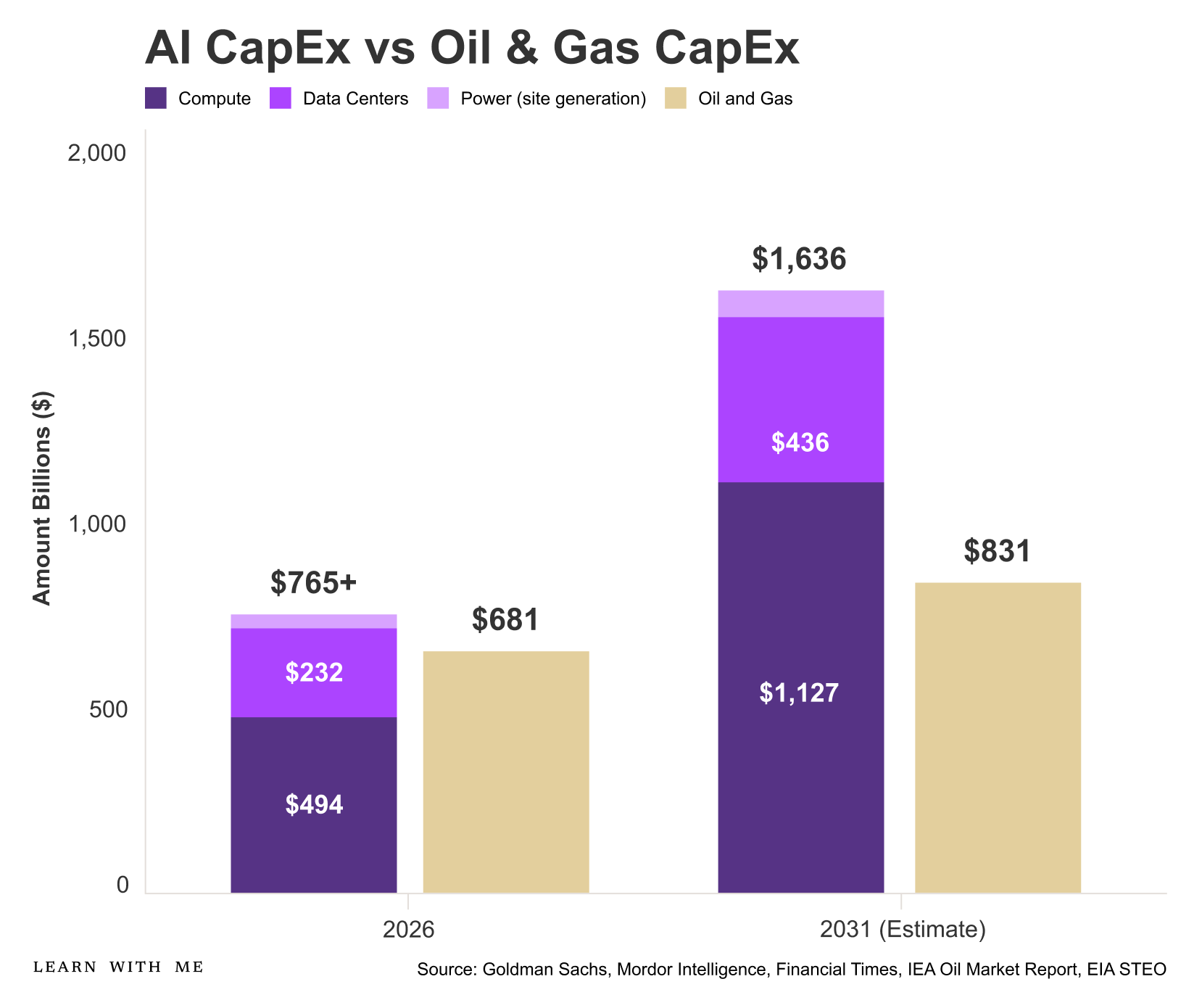
AI capex hit $765B in 2026, passing oil and gas for the first time. The resource powering AI is getting its first futures contract. Here is what has to be true for it to work…
“I actually believe a new asset class will be buying futures of compute. We just don’t have enough compute power right now.” - Larry Fink, CEO of BlackRock
This week, he was proven right.
CME Group, the world’s leading derivatives marketplace, and Silicon Data, the industry leader in GPU market intelligence and benchmarking, announced plans to launch compute futures contracts on October 5, 2026, pending regulatory review.
Why does compute need a financial market?
In 2026, AI capex reached $765B, passing oil and gas capex at $681B for the first time. By 2031, it is projected to nearly double. Morgan Stanley projects that AI’s diffusion across the global economy creates a $40T opportunity. That opportunity rests on a key resource: compute.
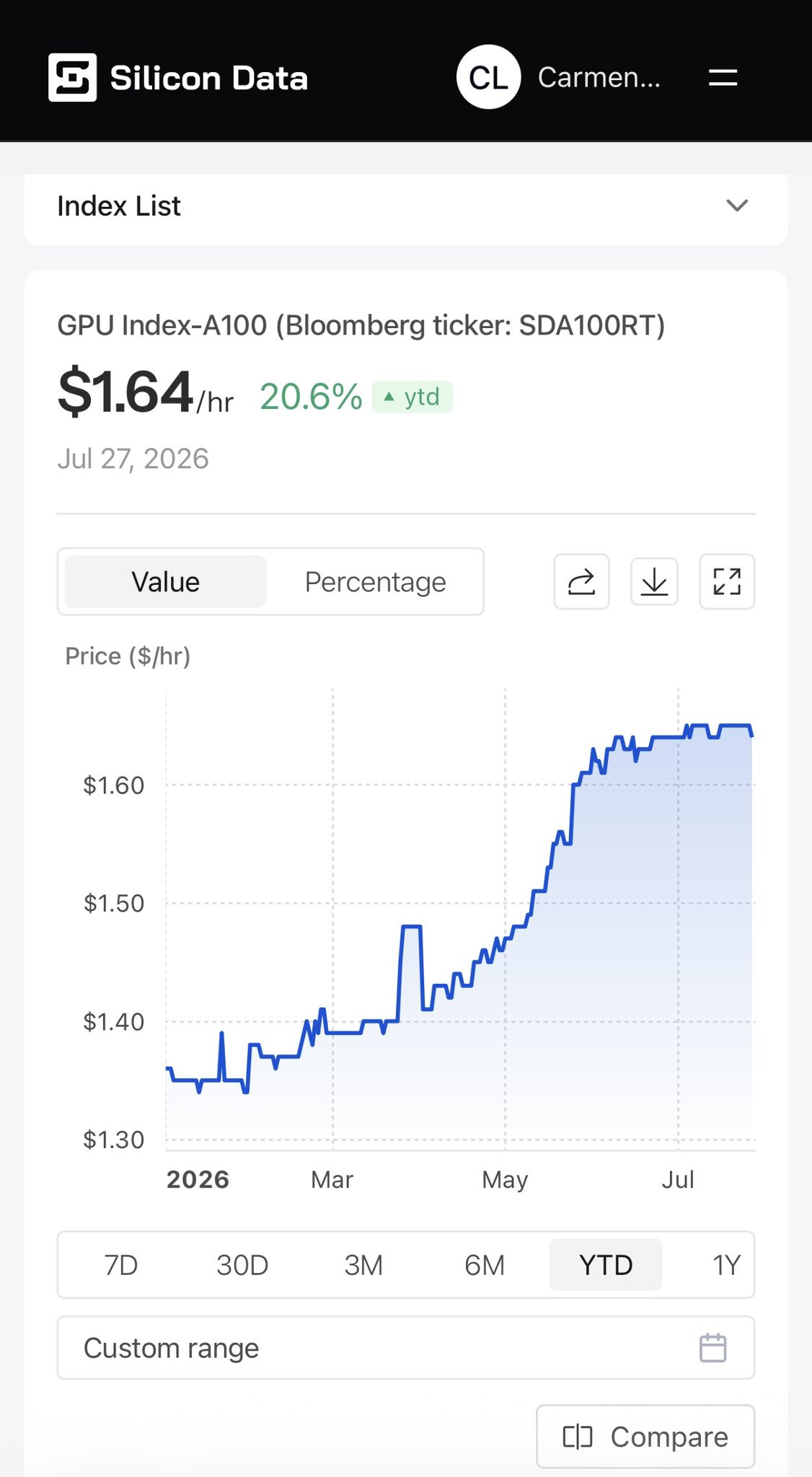
Silicon Data’s indices show compute demand, even for older generations, has risen sharply since the beginning of this year:
When this much capital moves into one industry, the people spending it need a way to protect themselves from prices moving against them.
Today, a producer who sells oil can buy a futures contract and lock in a price ahead of delivery. If the spot price falls, the contract holds revenue steady. Buyers on the other side use the same market to cap their fuel costs. Both sides take price volatility out of their business.
Compute has no equivalent of that yet, leaving anyone building or buying AI infrastructure exposed in three ways:
GPU rental prices are volatile, spiking when demand surges or plummeting when supply eases or a new chip is released, leaving AI companies unable to accurately budget for their largest input cost.
Every time Nvidia ships a faster chip, the previous generation loses rental value, and the collateral behind hardware loans shrinks with it.
A data center takes two to three years to build, but developers have limited ways to lock in what its compute will cost or earn. Every one of those decisions is a multi-billion-dollar bet.
These exposures create a need for compute futures. But before the market can scale, it has to face the same two problems that have limited other futures markets: concentration and interchangeability.
Attempts to build futures markets for onions, uranium, DRAM memory chips, and bandwidth all ran into one or both.
For compute, the concentration problem is mixed. The buyer side is diversifying as inference demand spreads across thousands of companies running production workloads. The selling side is broad and growing, with neocloud revenue passing $25B in 2025 across more than 60 providers. But the layer underneath remains heavily concentrated, with NVIDIA supplying most AI chips.
The second problem is interchangeability.
Today, compute prices are quoted in GPU-hours, the cost of renting a single GPU for one hour. But two GPUs of the same model can deliver different amounts of compute in an hour.
Silicon Data, working with academic co-authors, ran the same workload across 3,500 GPUs at 11 cloud providers. Even within the same chip model, they found meaningful variation. H100 performance differed by as much as 34.5% in one test, while the widest spread across the study reached 38%.
The first durable contracts may need to define several grades, much as energy markets use different fuels, locations, and delivery periods.
But the bigger question is what happens if compute futures work. Could compute become the next asset class to trade trillions in notional value and accelerate the AI economy?
We partnered with Silicon Data, whose price index underpins CME’s compute futures contract, to explore that question and the broader market taking shape around it:
The potential scale of compute as an asset class
How markets formed and failed around other scarce resources
What “compute” actually means in financial markets and the challenges to trading it
The different units of compute being traded and tested today
Who stands to benefit if the market succeeds
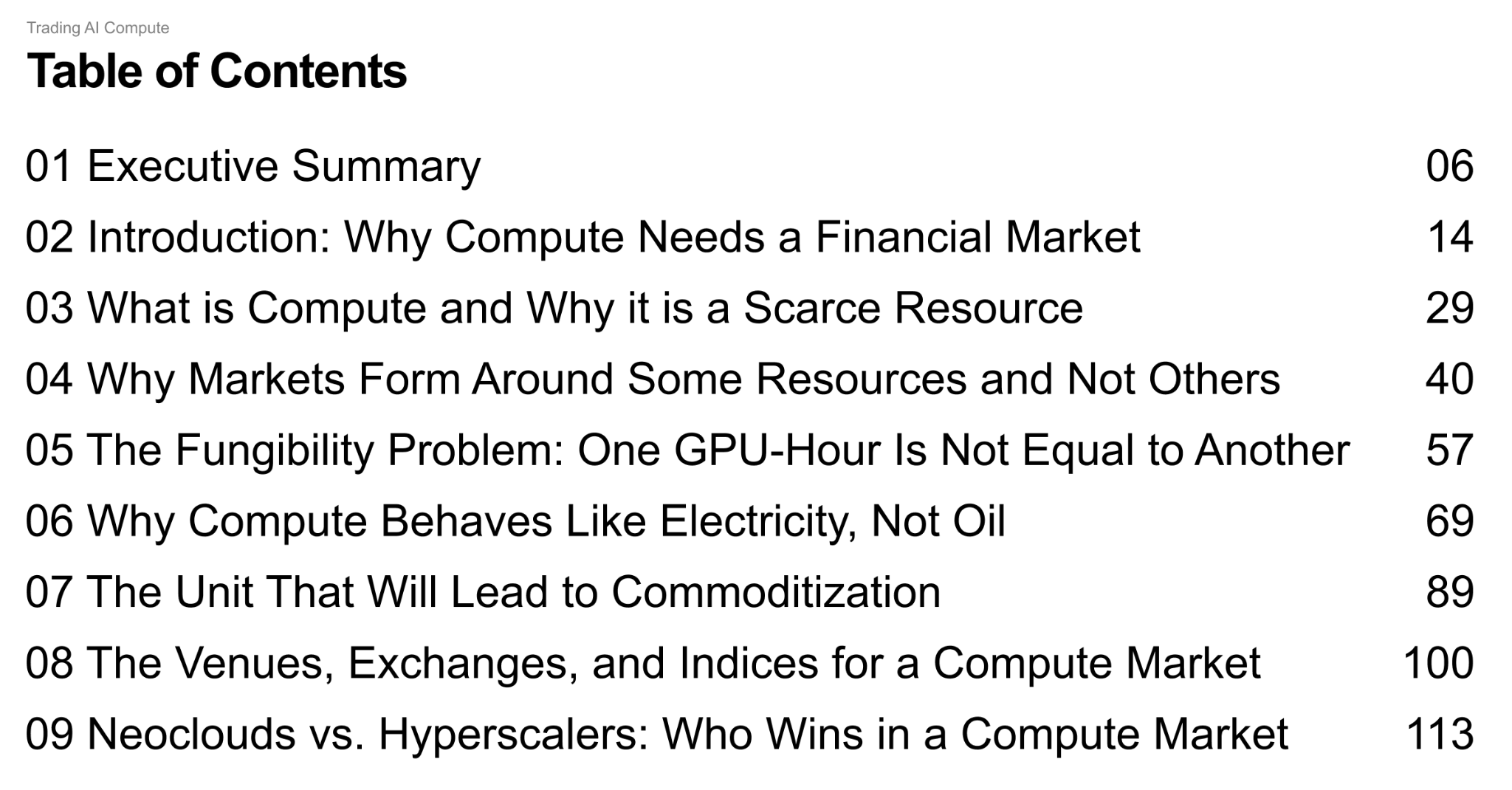
The result is a 129-page deep dive. Here’s a preview of the table of contents:
Read the deep dive below and let me know what you think.
Chamath
-
PS: If you are new to Learn With Me, my team and I publish Deep Dives every week. They represent 300+ hours of first-principles research, expert interviews, and truth-seeking analysis of what's happening in the world today.
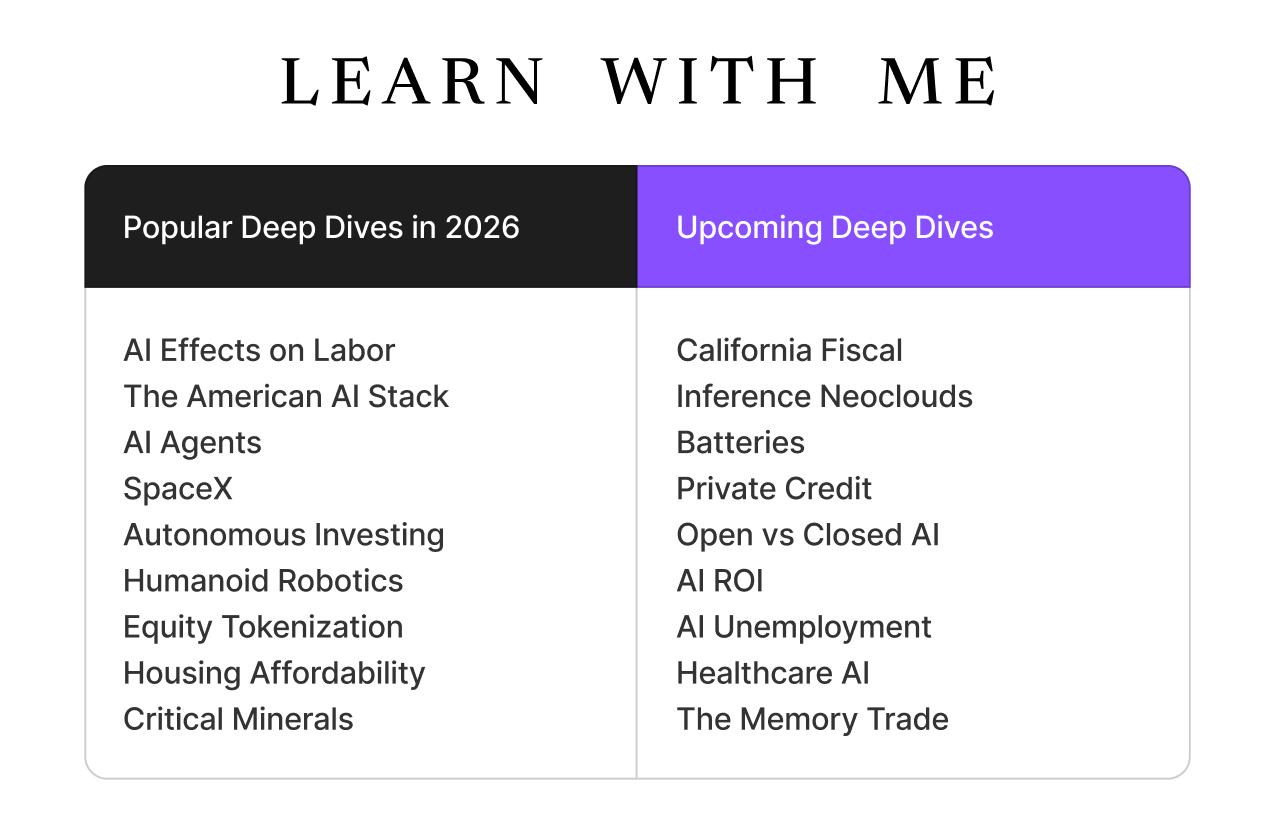
Here are some of the Deep Dives paid members have received this year, along with what’s coming next:
Disclaimer: The views and opinions expressed above are current as of the date of this document and are subject to change without notice. Materials referenced above will be provided for educational purposes only. None of the above will include investment advice, a recommendation or an offer to sell, or a solicitation of an offer to buy, any securities or investment products.
Deep Dive PDF below ↓