
Deep Dive: The Federal Reserve Explained
For two decades, investors built portfolios around a Fed that telegraphed its next move. Kevin Warsh has a different vision. Here is how the Fed works and what Warsh wants to change…
Newly confirmed Fed Chair Kevin Warsh chaired his first FOMC meeting this week.
In his first decision as Chair, Warsh held the benchmark rate at 3.5–3.75% in a unanimous vote, but the Fed’s own projections now show nearly half the committee expecting a hike before year-end, as seen in the chart below.
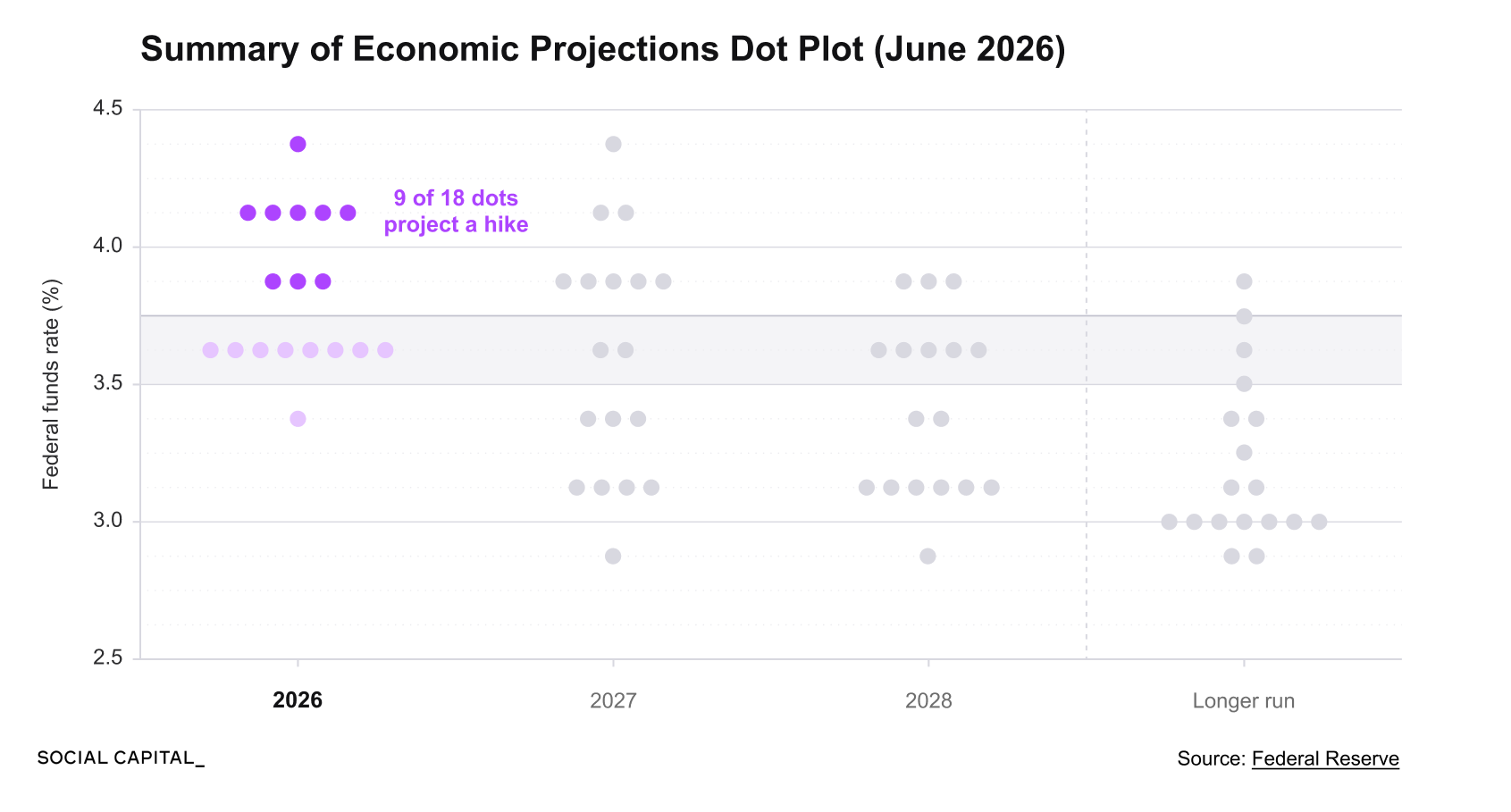
Warsh abstained from submitting a dot, signaling a potential change to the future Summary of Economic Projections (SEP).
Understanding why any of this matters starts with understanding how the Federal Reserve actually works.
You probably have a vague sense of what the Fed does.
They raise and lower rates. They focus on employment. But most people, even financially literate ones, could not tell you why it exists, how it actually works, or what it is really trying to do. So let’s examine it from the ground up.
The Federal Reserve controls the cost of borrowing in the United States.
It does this by setting the federal funds rate: the rate banks charge each other to borrow money overnight. That rate anchors the cost of money across the financial system.
Treasury yields and other market rates move in response to the current rate and where investors expect it to go. Lenders then add a premium for time, credit risk, and profit, producing the rates charged on mortgages, corporate loans, credit cards, and nearly every other form of borrowing.
When the federal funds rate rises, borrowing becomes more expensive. Households spend less, companies invest and hire less, and investors place a lower value on future earnings. Bond prices, stock valuations, real estate values, retirement accounts, and the strength of the dollar all adjust in response.
This makes the Fed the most consequential institution in the American economy.
Kevin Warsh is now in charge of it, and he has a clear vision for how it should change.
In April Senate Banking Committee testimony, Warsh articulated a leaner central bank: one that acts less, telegraphs less, and treats market surprise as a feature rather than a flaw. No Fed Chair in the last two decades has operated this way.
If that vision were to become a reality, it would reshape how the Fed interacts with markets across four main dimensions:
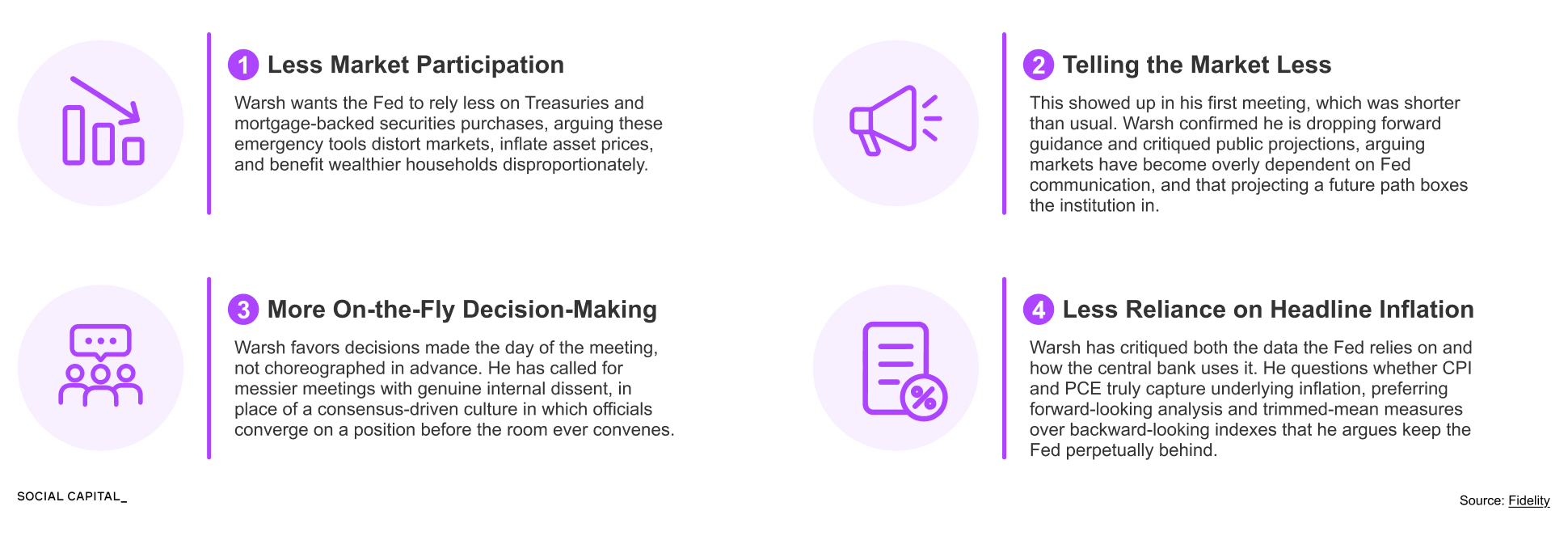
As the Fed communicates less and surprises more, investors have less certainty about what comes next. Less certainty means higher risk premiums, which could push long-term bond rates up and stock valuations down, even without a single rate hike.
That is the direction Warsh wants to take the Fed. Here is his starting point:
CPI inflation at 4.2% year-over-year, a three-year high, driven by an energy-price spike, well above the Fed’s 2% target
Unemployment at 4.3%, steady in the 4-5% range over the past two years
Jerome Powell, the outgoing Fed Chair, is staying on the board until 2028, retaining a vote on every rate decision Warsh makes
To see where the Fed goes next, we need to layer in the forces shaping its rate decisions: its history, its private-public hybrid architecture, its modern toolkit, and the political and market pressures surrounding every decision.
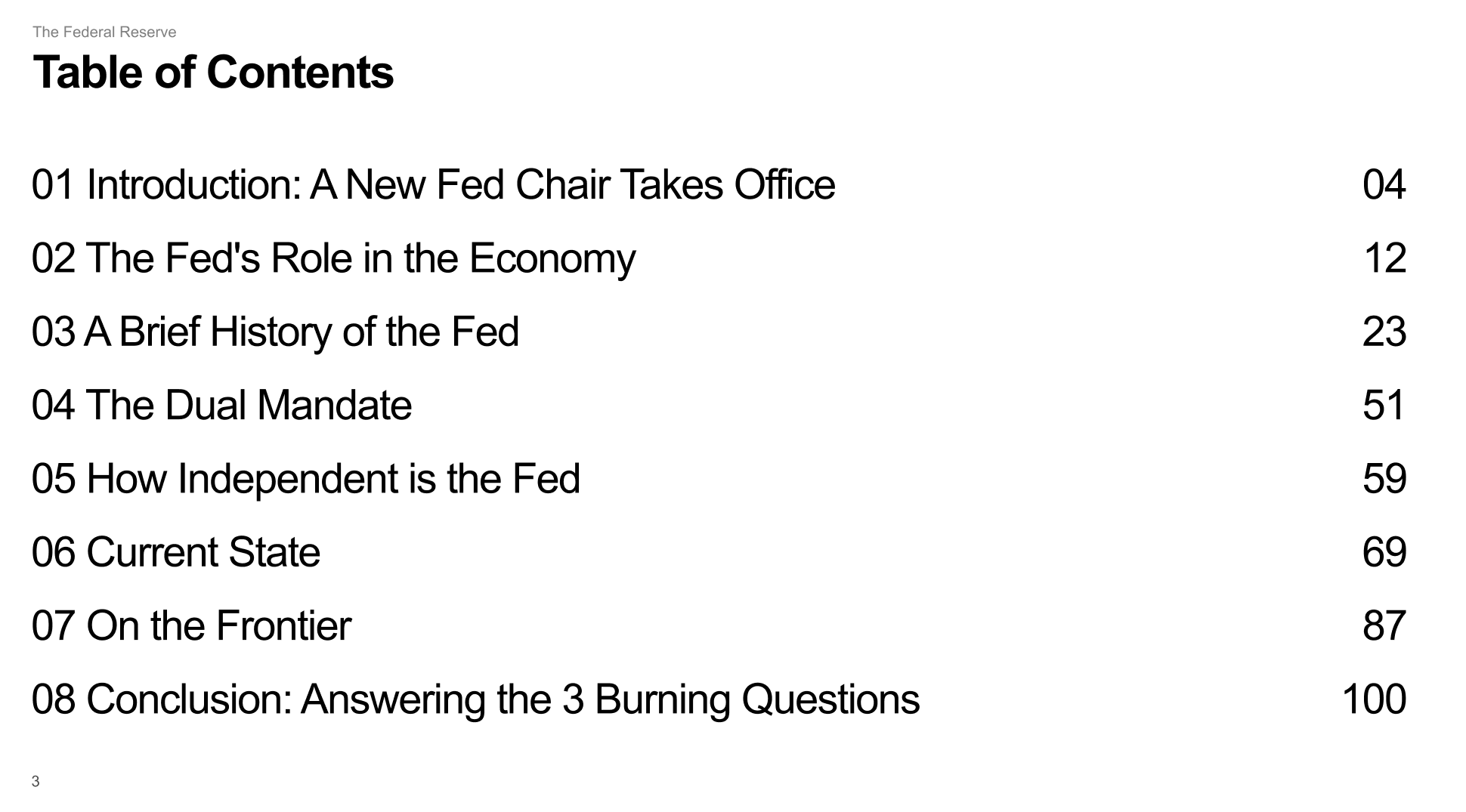
My research team traced the Fed from its creation to the institution Kevin Warsh now inherits. The result is a 108-page deep dive on how it was built, how power moves through it, and whether it can remain independent under today’s political and market pressure.
Inside, we’ll cover:
Why did America spend its first century debating whether a central bank was unconstitutional, and what finally broke that resistance in 1913?
If the President can’t fire the Fed Chair, why is the Federal Reserve vulnerable to political pressure?
Every Fed Chair has faced a defining test. What were those tests, how did Warsh’s predecessors respond, and what will define his tenure?
How do markets respond after every Fed Chair transition in history?
Read the deep dive below and let me know what you think.
Chamath
Disclaimer: The views and opinions expressed above are current as of the date of this document and are subject to change without notice. Materials referenced above will be provided for educational purposes only. None of the above will include investment advice, a recommendation or an offer to sell, or a solicitation of an offer to buy, any securities or investment products.
Deep Dive PDF below ↓