
How Two Companies Built a $71+ Billion Drug Class
In 2025, two drugs earned more than double the combined revenue of OpenAI and Anthropic and reached under 2% of the people who qualify. This is a deep dive on the biology, the economics, and where...
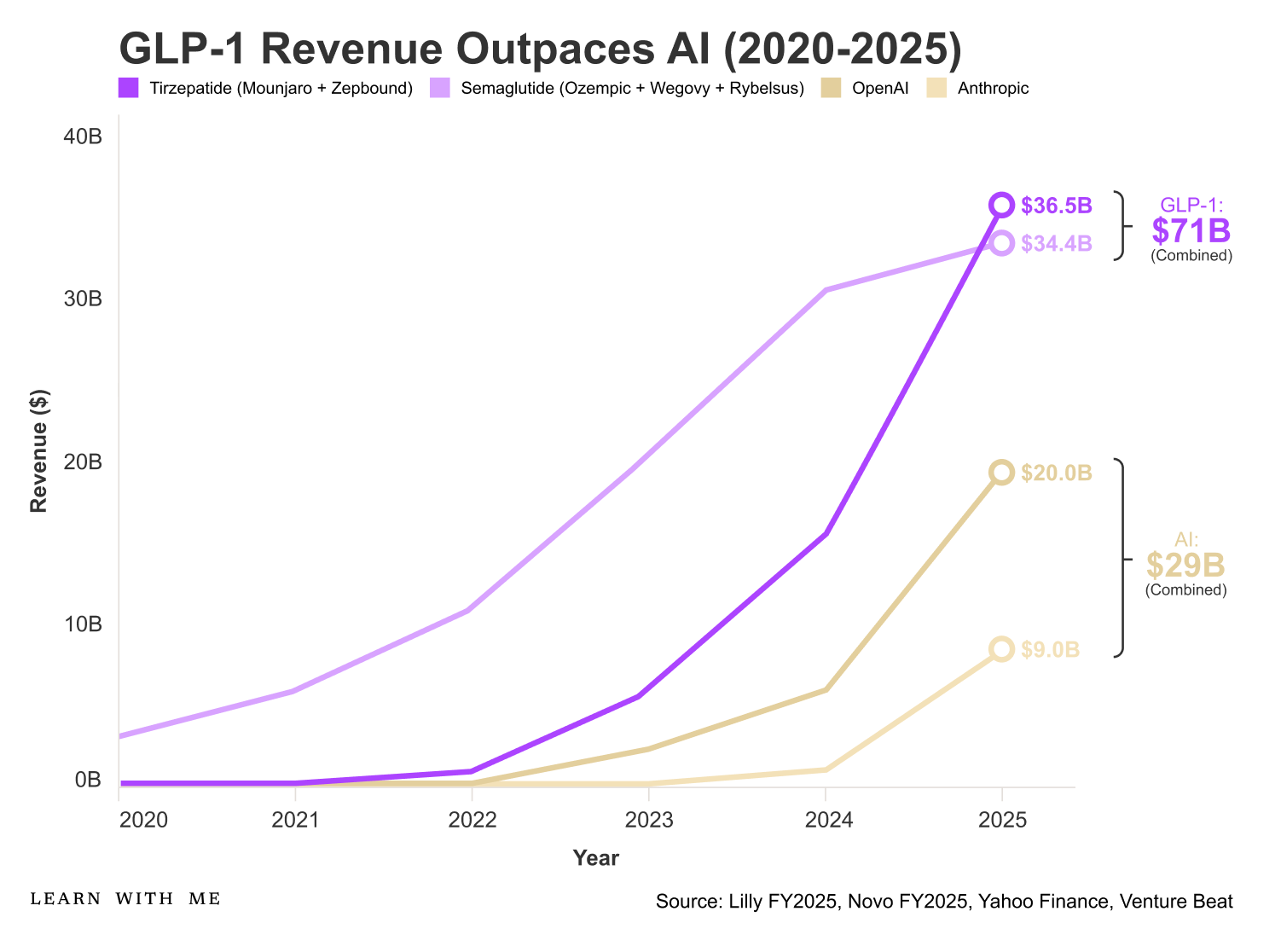
In 2025, two drugs earned $71 billion between them, more than double the combined revenue of OpenAI and Anthropic that year.
The drugs are semaglutide, which Novo Nordisk sells as Ozempic and Wegovy, and tirzepatide, which Eli Lilly sells as Mounjaro and Zepbound.
Tirzepatide became the best-selling pharmaceutical in the world. Though AI revenue is accelerating and the gap is closing, through 2025, two molecules out-earned the two leading frontier AI companies combined, and they did it while reaching fewer than 2% of the roughly 800 million people who would qualify for them globally.
Despite mainstream adoption and public testimonials from celebrities like Oprah, Serena Williams, and Elon Musk, in America alone, under 6M of the 137M clinically eligible adults are treated. Goldman Sachs and Morgan Stanley both project 15 to 20% penetration by the early 2030s, about 3-4x what it is now.
The Indication Cascade
A hormone is a chemical messenger that travels through the bloodstream, meaning it reaches every tissue the blood reaches. Nothing about the molecule changes between those tissues, only the cell receiving it.
Testosterone is the clearest example. The same molecule tells hair follicles on the scalp to shrink, follicles on the face to grow, raises competitive drive in the brain, and stimulates sperm production in the testes.
GLP-1 works the same way. Its receptors sit on the insulin-producing cells of the pancreas, on neurons in the hypothalamus, on the stomach lining, and in the brain’s reward circuitry. This is why we see such varied changes across the whole body.
Every GLP-1 approval since 2017 has surfaced an effect nobody designed for, and a later trial has turned that effect into the next approved indication. Diabetes patients lost weight, which produced the obesity label in 2021. The obesity drug then cut major cardiovascular events by 20%, which produced the cardiovascular label. A kidney trial cut major kidney outcomes by 24%, and on the day those results were announced, shares in DaVita and Fresenius, the two largest dialysis operators in America, each fell about 17%, because a drug that slows kidney decline shrinks the dialysis population. The pattern has since run through sleep apnea and liver disease.
Each turn of that cycle adds tens of millions of newly eligible patients and reprices an industry that was not in the conversation the year before. Walmart’s U.S. CEO said the company could already see GLP-1 users buying smaller baskets, and Nestlé now sells a frozen-meal line designed for them.
So how far does the cascade run? In January 2025, Washington University followed 215,970 patients on these drugs, matched to controls, across 175 conditions. Risk fell on 42 of them and rose on 19.
Of the 42, the one with no incumbent is addiction. GLP-1 receptors sit in the brain’s reward circuitry, and the same mechanism that quiets food noise appears to dampen the response to a drink or a drug. Around 36 million Americans are affected by alcohol, opioids, and stimulants.
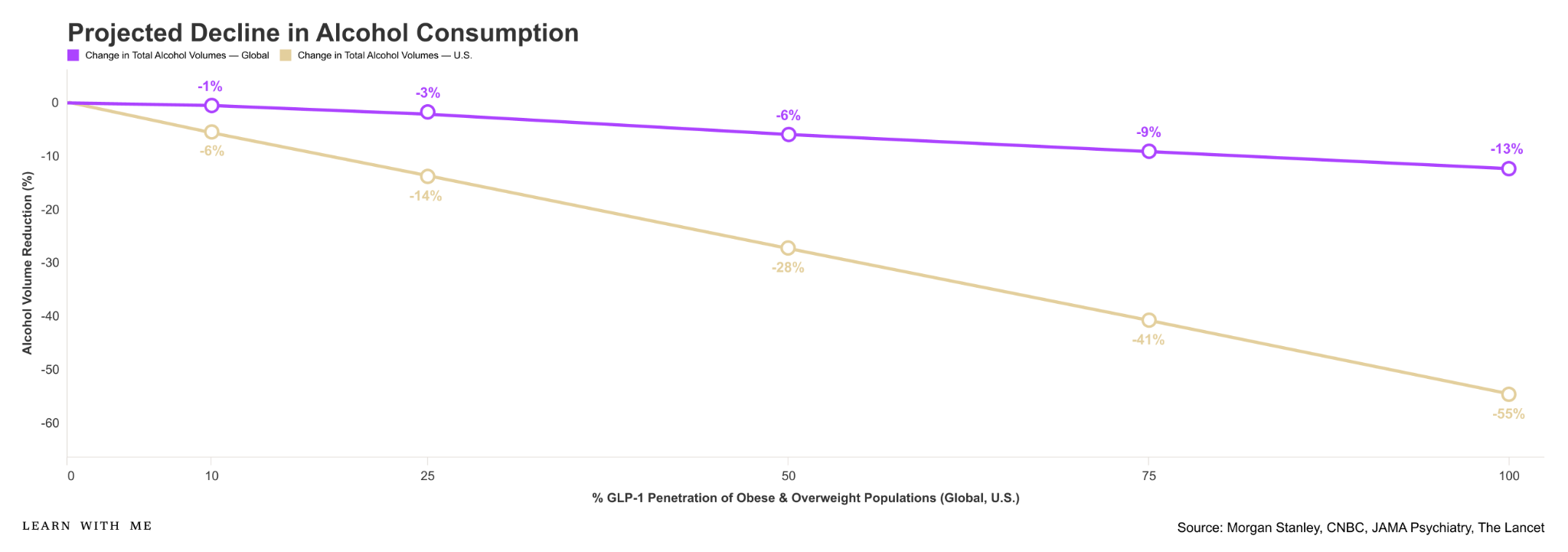
This leads to an ever-growing addressable market for these companies as new trials reveal further effects.
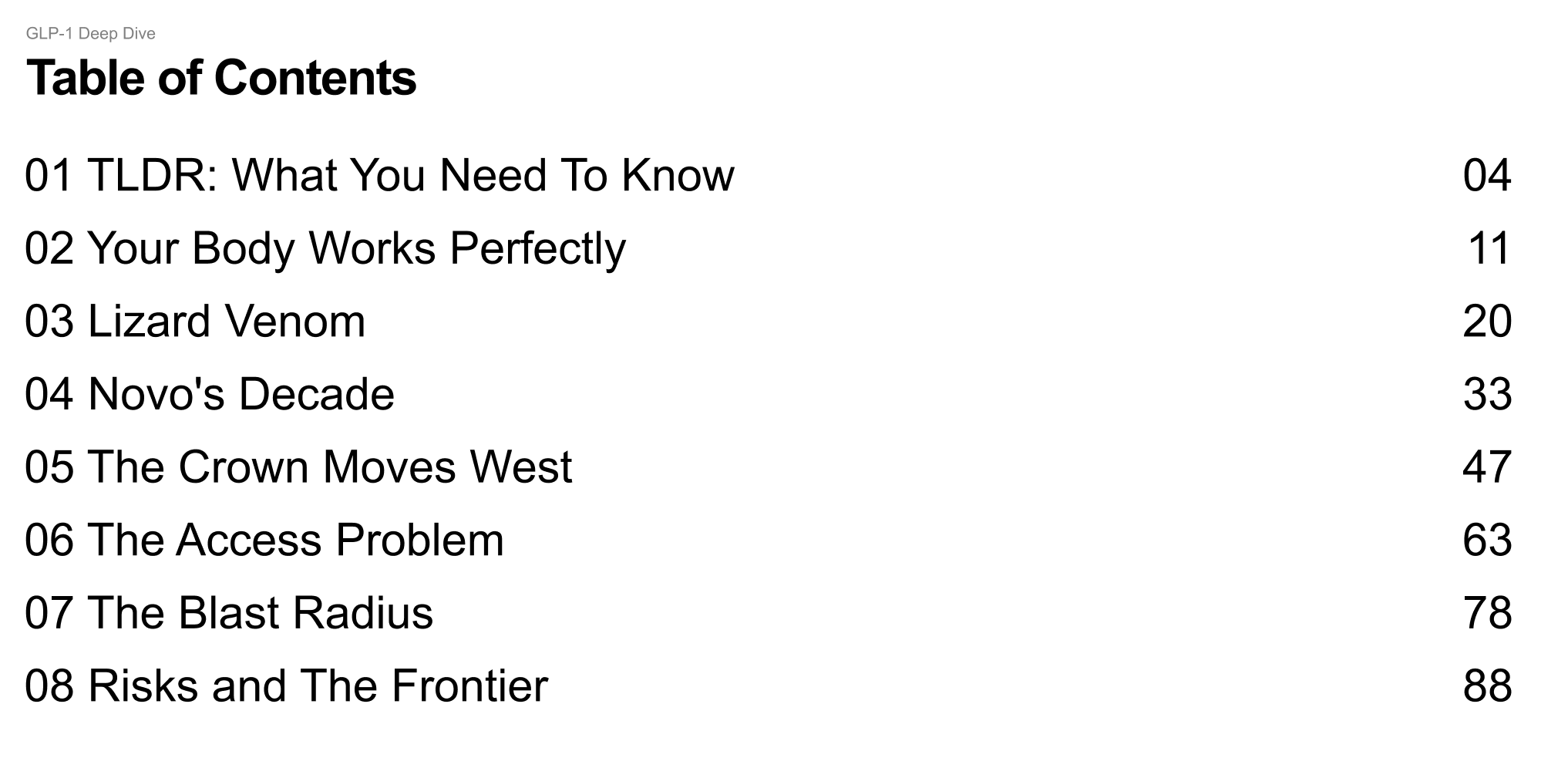
My researchers at Social Capital spent months on this topic and created a 99-page deep dive that starts with why the body defends the weight it already has and ends with why this drug matters beyond obesity.
One of the many points we unpacked: GLP-1 is the first commercially significant proof of concept. Find the hormone the body uses to run a system, engineer a version that survives in the bloodstream, and you treat the system instead of its symptoms.
Here’s what else you can expect to learn:
Why no third company has built one of these, and what a rival would have to assemble to try.
The receptor the industry wrote off, how Lilly turned it into the best-selling drug on earth, and the scaling rule every generation since has followed.
How a hormone that survives two minutes in the bloodstream became a once-weekly injection, and the desert lizard that made it possible.
All 175 outcomes measured, the 19 that got worse, and what the confirmatory addiction trials could do to the size of this market.
What stops this: who quits, what comes back when they do, and the four places the pipeline is looking for the fix.
If you’re interested, learn with me below. Hope you enjoy reading!
Chamath
Disclaimer: The views and opinions expressed above are current as of the date of this document and are subject to change without notice. Materials referenced above will be provided for educational purposes only. None of the above will include investment advice, a recommendation or an offer to sell, or a solicitation of an offer to buy, any securities or investment products.
Deep Dive PDF below ↓