
Deep Dive: 5 Forces Causing The Population Collapse
In my 2021 Social Capital Annual Letter, I warned that a demographic time bomb was already ticking. Since then, the U.S. total fertility rate has fallen another 4% to a record low of...
In my 2021 Social Capital Annual Letter, I warned that a demographic time bomb was already ticking.
At the time, U.S. Census data showed deaths exceeding births in more than 73% of U.S. counties. Even after stripping out pandemic-related deaths, population growth had still neared all-time lows.
Since then, the U.S. total fertility rate has fallen another 4% to a record low of 1.6, extending a long-term decline of 57% since 1960.
And the U.S. is not an outlier.
110 out of 204 countries now sit below the total fertility replacement level of 2.1.
By the year 2100, it’s expected that over 90% of countries will fall below this level.
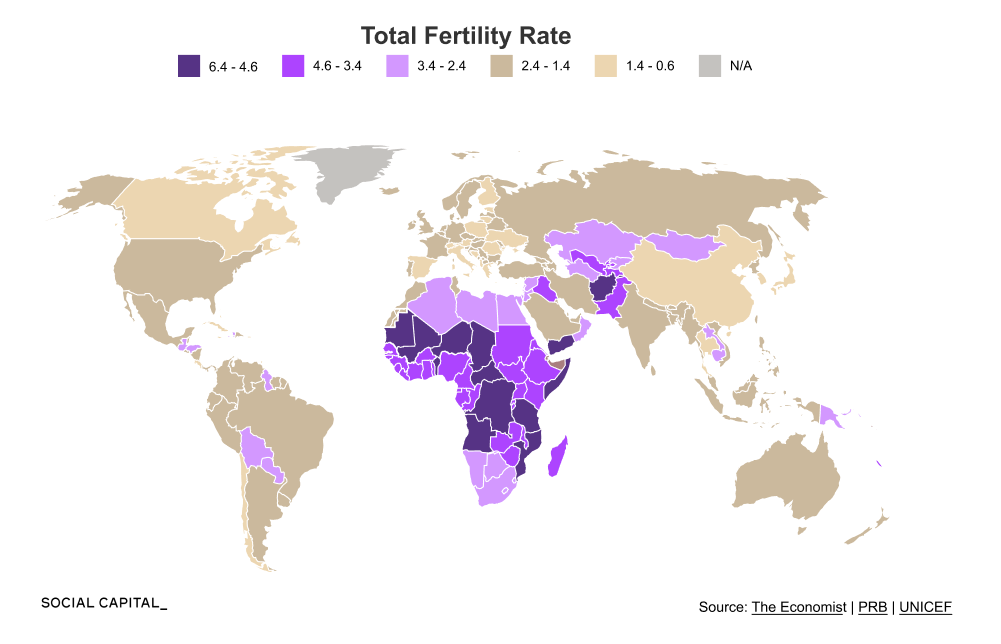
When Elon posted about this last year, it got 44 million views:

Historically, population decline has been driven by external and involuntary shocks like famine, disease, or war. Notable examples include:
The Black Death in the 14th century
The collapse of the Roman Empire
China’s Great Famine
Unlike past population declines, today’s is voluntary and structural.
To understand why, my research team at Social Capital examined the issue from first principles.
What emerged in our research was five structural forces shaping fertility decisions across modern societies, starting with the most fundamental constraint:
1. Biology: The Limiting Factor
Human fertility is age-dependent.
The average woman in developed countries now has her first child around age 29. But by this point, fertility has already begun to decline. At that age, if 100 healthy couples try to conceive in a given month, only about 20–25 will succeed.

Meanwhile, population-level testosterone in men is declining approximately 1% every year. Low testosterone levels are associated with impaired sperm generation. And this decline persists even after controlling for age, health, and lifestyle.
That means a 30-year-old man today has roughly 20% lower testosterone than a 30-year-old from his father’s generation.
Both sides of the reproductive equation are under pressure.

While biology defines the limits of human reproduction, the next force changes how people interact with those limits:
2. Technology: Reshaping Human Reproduction
Modern reproductive technologies have fundamentally decoupled sex, relationships, and childbirth.
Technologies of decoupling, such as prevalent contraceptives and legal abortion, separated the act of sex from its potential reproductive consequences.
Technologies of extension, such as IVF, egg freezing, and fertility monitoring, enabled people to extend reproduction beyond the natural window of peak fertility.
Technologies of substitution, such as dating apps, digital content, and algorithmic social platforms, have quietly reshaped how people form (or fail to form) relationships at all.

The net effect is that modern technology is exerting a downward pressure on fertility outcomes, largely because avoiding or delaying pregnancy is simpler and more economically accessible than enabling it after fertility has declined.
Which brings us to the next force:
3. Economics: Childbearing Costs More Today
In pre-industrial agrarian economies, children worked and contributed economically to the household. In modern economies, children are primarily a financial cost rather than an economic asset.
In the United States, it’s estimated that it costs roughly $310,000 for a middle-income household to raise a child to age 17, excluding college.
At the same time, key family expenses such as housing, childcare, and education have grown faster than household income, increasing the financial trade-offs associated with parenthood.

If financial constraints were the dominant driver, one would assume wealthier countries would have the highest birth rates. In reality, the opposite pattern appears.
Many of the world’s richest countries have fertility rates below 1.5, while several of the poorest maintain rates above four children per woman.
To understand that dimension, we need to examine the role of cultural norms and social incentives that shape reproductive decisions.
4. Culture: A Mass Shift In Desire
French philosopher René Girard argued that humans desire what others around them desire.

According to this theory, if people prioritize career achievement and personal independence over raising a family, those desires propagate socially.
The inverse is also true: if more people around you have children, the social pull toward parenthood increases.
There’s data to support this. According to research published by the American Sociological Review, a woman’s probability of having a child increases significantly in the 12 to 24 months after a close friend gives birth, peaking at around 2 years.
In short, fertility decisions, in either direction, are socially contagious.
But culture alone does not determine fertility outcomes; there’s another factor we should consider:
5. Policy: How Government Intervenes
When governments respond to population decline or growth, policy typically falls into two categories: soft policies and hard policies.
Soft policies act indirectly, shaping fertility through economic security, cultural norms, and incentives around family formation.
Hard policies rely on legal mandates and enforcement to directly alter reproductive behavior.
Whether through incentives or coercion, institutional interventions often generate backlash and produce questionable long-term influence on fertility.
The 5 Forces Converge
With these forces applying pressure across multiple dimensions of human reproduction, the demographic time bomb I referred to in 2021 has continued ticking.
The data is striking, but the cause and effect behind each of these forces runs much deeper. That is why my research team put together a 100-page Deep Dive to investigate further. Here are the questions we set out to answer:
What does male fertility data reveal about our environment that almost no one is talking about?
How did three distinct technologies each reshape the relationship between sex, relationships, and reproduction, and how did their effects compound?
Which policies have meaningfully moved the needle on fertility historically, and what does China’s failed reversal tell us about their hard limits?
How does the decision to have children spread through social networks, and can a negative feedback loop ever be reversed?
How do some communities sustain high birth rates inside low-fertility economies?
What does a 1968 mouse experiment with unlimited food, water, and space reveal about why wealthy societies stop reproducing?

If you want to learn more with me, sign up below to read the full Deep Dive (and all our past releases).
Chamath
Disclaimer: The views and opinions expressed above are current as of the date of this document and are subject to change without notice. Materials referenced above will be provided for educational purposes only. None of the above will include investment advice, a recommendation or an offer to sell, or a solicitation of an offer to buy, any securities or investment products.
Deep Dive PDF below ↓