
Deep Dive: Prediction Markets
Prediction markets have grown to over $6 billion in weekly trading volume: more than 100x in just over 24 months. But with that growth comes a new set of questions...
Before the 2024 election, prediction markets were primarily a niche curiosity with weekly trading volumes hovering around $50 million.
Today, prediction markets have over $6 billion in weekly trading volume: more than 100x in just over 24 months.
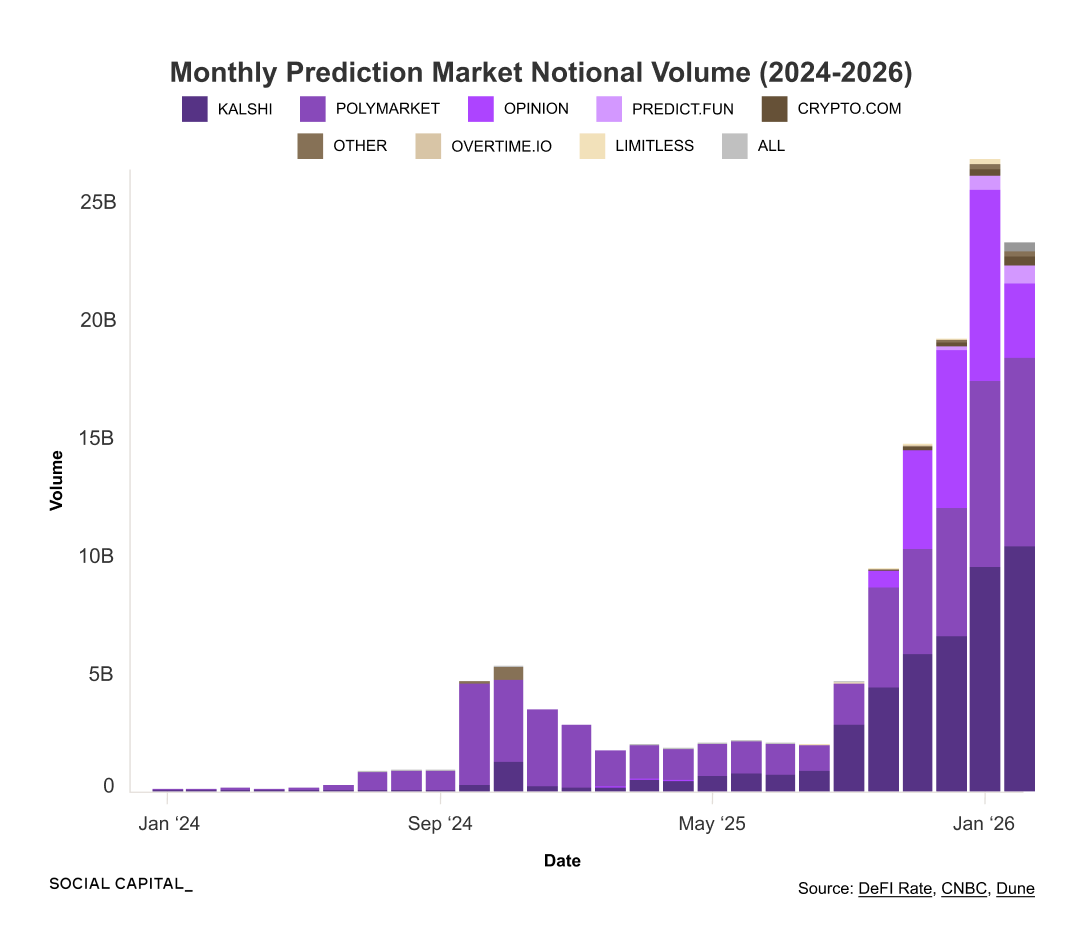
The 2024 presidential election marked the move of prediction markets into the mainstream. The two largest prediction market platforms, Polymarket and Kalshi, saw over $4.2B in trading volume on the election event alone.
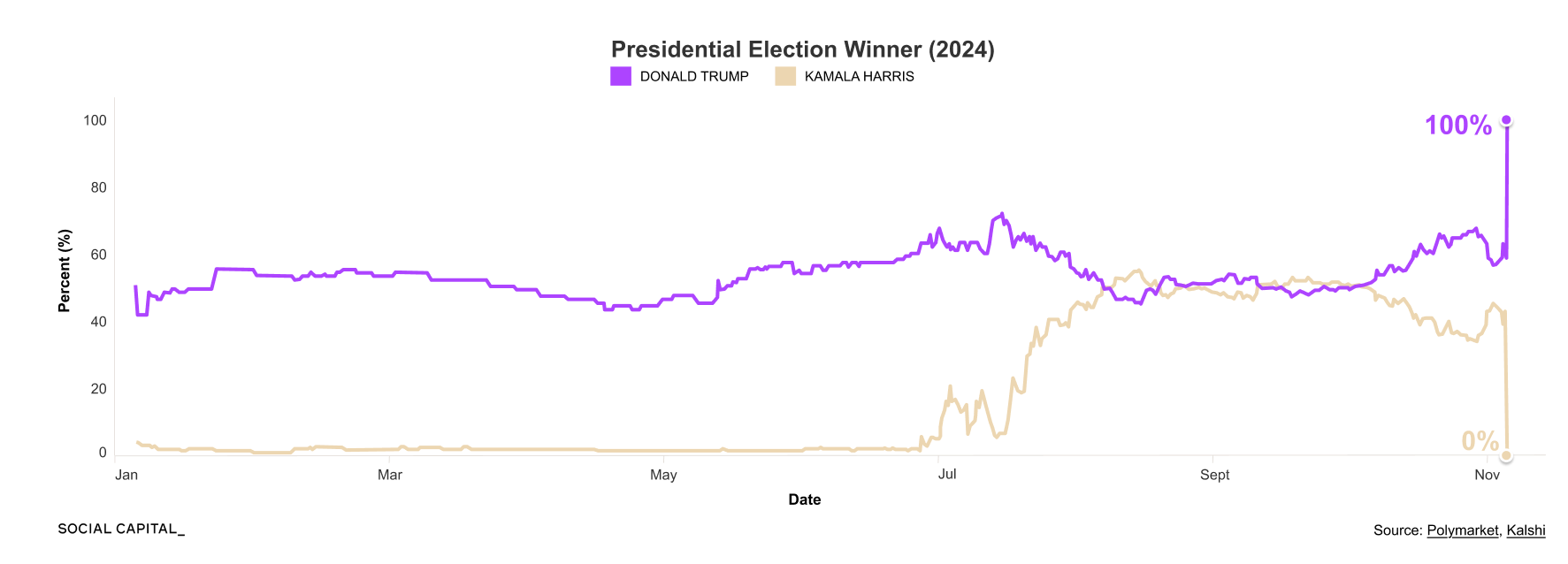
While traditional polling remained largely static within a margin of error, prediction markets reacted to new information in real-time, moving ahead of polls, calling swing states days early, and correctly pricing the eventual outcome.
This was more than just people placing bets. This was a demonstration of markets acting as truth machines.
How Markets Produce Signals
A prediction market begins with a simple, binary contract.
When an exchange lists a contract, it’s tied to a specific, verifiable event. Traders can buy either outcome, YES or NO, based on their belief in the likelihood of the event happening or not.
If the trader bought “YES” and the event occurs, the contract is worth $1. If the event does not occur, it’s worth $0.
When a contract trades at $0.65, the market is collectively pricing a 65% chance of the event occurring.
In other words, the price of a bet reflects the collective probability estimate of all participants, allowing the market to know more than any single individual. By aggregating dispersed information, these markets produce a measurable signal.
From a regulatory perspective, however, the legality of these markets was unclear until the Kalshi v. CFTC (Commodity Futures Trading Commission) case in 2024.
The eventual result of that case allowed market participation and capital to begin scaling.
The Liquidity Network Effect
Liquidity is essential for a market to function. The market needs an adequate number of willing buyers and sellers for a given contract at various prices.
Without sufficient liquidity, even small trades can cause large price movements, which result in poor price discovery and wide bid/ask spreads. In other words, there can be a large gap between the price people are willing to pay and the price others are willing to sell at.
Conversely, when more traders enter the market, liquidity improves, price signals sharpen, and more traders follow. This is the liquidity network effect in action. As trading volume increases, the market becomes more efficient.
While the CFTC ruling removed constraints on institutional liquidity from entering centralized exchanges like Kalshi, decentralized markets were also growing in parallel.
Polymarket, which is decentralized, grew its liquidity through structural advantages: near-instant settlement, global access without traditional banking relationships, and the ability to spin up new event contracts quickly without per-contract regulatory approval.
Now, both Kalshi and Polymarket are formal participants in the U.S. market, following Polymarket’s acquisition of QCEX, a CFTC-licensed exchange, in July 2025.
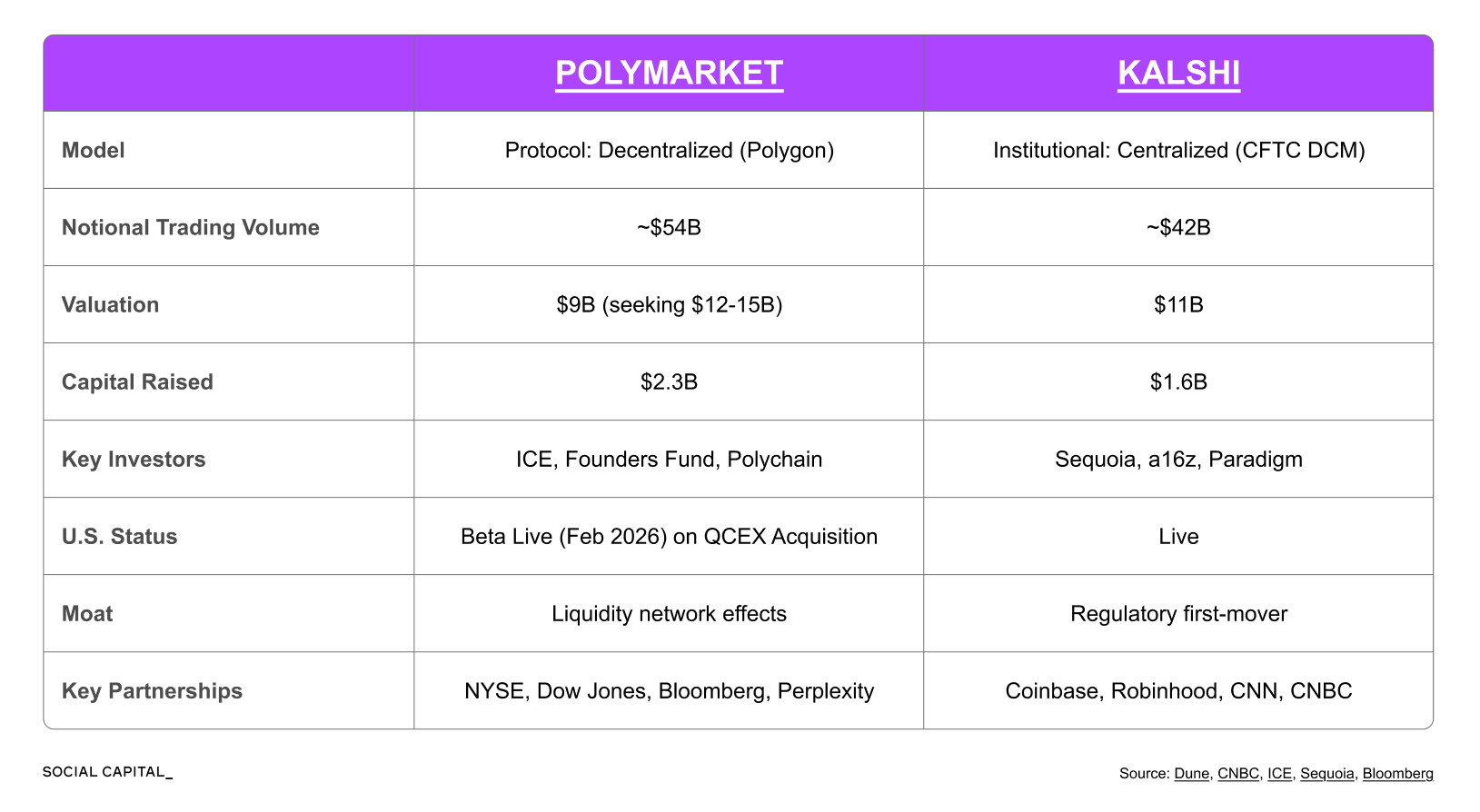
Despite different architectures and settlement structures, both exchanges have continued to grow, driven by regulatory clarity that legitimized the category.
This also helped to unlock broader distribution.
Unlocking Consumer Distribution
Prediction markets are now accessible through platforms like Robinhood, Coinbase, DraftKings, and FanDuel.
This unlocks 100M+ retail accounts that are already linked to bank accounts, giving distribution of prediction markets through platforms people are already using without needing to acquire users from scratch.
With new technology enabling easier access, regulatory clarity, and increased trading volume that improves price signals, prediction markets have exploded and are expected to continue growing.
Research featured by CNBC projects prediction markets could approach $1 trillion in annual trading volume by 2030, or roughly $19.2 billion per week.
But with that growth comes a new set of questions.
In a recent All-In interview with SEC Chairman Paul S. Atkins and CFTC Chairman Michael S. Selig, we explored key issues: exposure to manipulation, the path to regulatory clarity, the industry’s long-term outlook, and the role AI will play in shaping these markets.
To go further, our research team at Social Capital developed a 60+-page deep dive into prediction markets.
When you read it, you’ll learn:
The architecture of prediction markets, their key differences, advantages, and disadvantages.
The pivotal moment for prediction markets that unlocked a wave of institutional investment.
Key markets in the space and how the competitive landscape is shifting.
How different players in the ecosystem are capturing value.
How prediction markets can be used in the private sector to surface latent intelligence.
The endgame for prediction markets in the U.S.
Applicable insights on how to interpret and use this new information signal.
If you want to learn with me, sign up below to read the full Deep Dive (and all our past releases).
Chamath
Disclaimer: The views and opinions expressed above are current as of the date of this document and are subject to change without notice. Materials referenced above will be provided for educational purposes only. None of the above will include investment advice, a recommendation or an offer to sell, or a solicitation of an offer to buy, any securities or investment products.
Deep Dive PDF below ↓