
Neuralink's 21 Telepathy Trials in 2 Years
Neuralink expands to 21 "Telepathy" trials, Figure AI unveils new full-body control AI model, DeepMind releases DNA AI model, and more.
What I Read This Week: a summary of the content that I consumed this week…
Caught My Eye…
1) Neuralink: 2 Years and 21 Trials
Neuralink has officially expanded its human clinical trials to 21 participants worldwide, marking a significant jump from the 12 reported late last year. The focus has shifted from basic cursor control to “Telepathy” for patients with ALS and spinal cord injury.
“There were moments I realized, oh, this is a much bigger deal than I thought… [the Neuralink] is not only able to follow along, but it may also anticipate what you want to do next just a little bit faster than you can think it.” - Noland, the first human to receive a Neuralink implant
New data shows that signal quality has improved in 18 of the 20 most recent cases, thanks to crucial insights from Noland’s surgery. In the coming months, the team will improve the implant and surgical process by tripling the electrode count to 3,000. This will increase neural signal volume and thread retention.
Beyond basic communication, Neuralink has now opened up a new clinical trial for “VOICE“. The goal of the study is to read signals from brain regions involved in speech production and restore real-time speech, aiming to achieve 140 words per minute. Additionally, Blindsight, their new product to generate visual perception, will soon start trials after receiving FDA Breakthrough Device designation.
A new Deep Dive about Neuralink will be launching soon. It will cover why Elon started the company, the history of Brain Computer Interfaces (BCI), and the key innovations that the company pioneered.
2) The Helix 02: Full Body Control with One System
Figure AI just unveiled Helix 02, a second-generation Vision-Language-Action (VLA) model that powers their new Figure 03 humanoid robot. The breakthrough here is Full-Body Autonomy (not teleoperated), in which the robot no longer separates walking from hand use. This challenge of loco-manipulation, the ability for a robot to move and manipulate objects together, has been one of the hardest problems in robotics due to each action shifting and changing the balance of the other actions.
The Figure 03 robot now comes with “Palm Cameras” that provide a second set of eyes, allowing the robot to see what it’s holding even when its head camera is blocked. This, along with its tactile sensors allow it to feel forces as light as 3 grams, enabling it to pick a single pill out of a bottle or handle a delicate syringe. Helix 02 can then leverage all onboard sensors and connect them directly to each actuator through a single visuomotor neural network.
This model replaces over 100,000 lines of manual C++ code with System 0, a neural network trained on 1,000+ hours of human motion, that now sits at the base layer and controls human-like whole-body balance. The next layer is System 1, which connects all sensors and translates their inputs into joint-level control of the entire robot. System 2 sits on top and remains the semantic-reasoning layer, processing scenes and language and creating latent goals for System 1.
A larger Deep Dive into the emerging industry of Humanoid Robotics is also in the works. Subscribe to our Substack if you haven’t to be notified when it releases.
3) Google DeepMind: AlphaGenome DNA Breakthrough
Google DeepMind just published AlphaGenome in Nature, a model that does for DNA what AlphaFold did for proteins. The text of the human genome has been captured since 2003, but AlphaGenome is like a grammar teacher, helping us understand how to best understand and order the text. This AI tool enables analysis of up to 1 million base pairs simultaneously to predict how DNA variants affect biological functions. It notably targets the remaining 98% of our DNA that doesn’t code for proteins but regulates everything else.
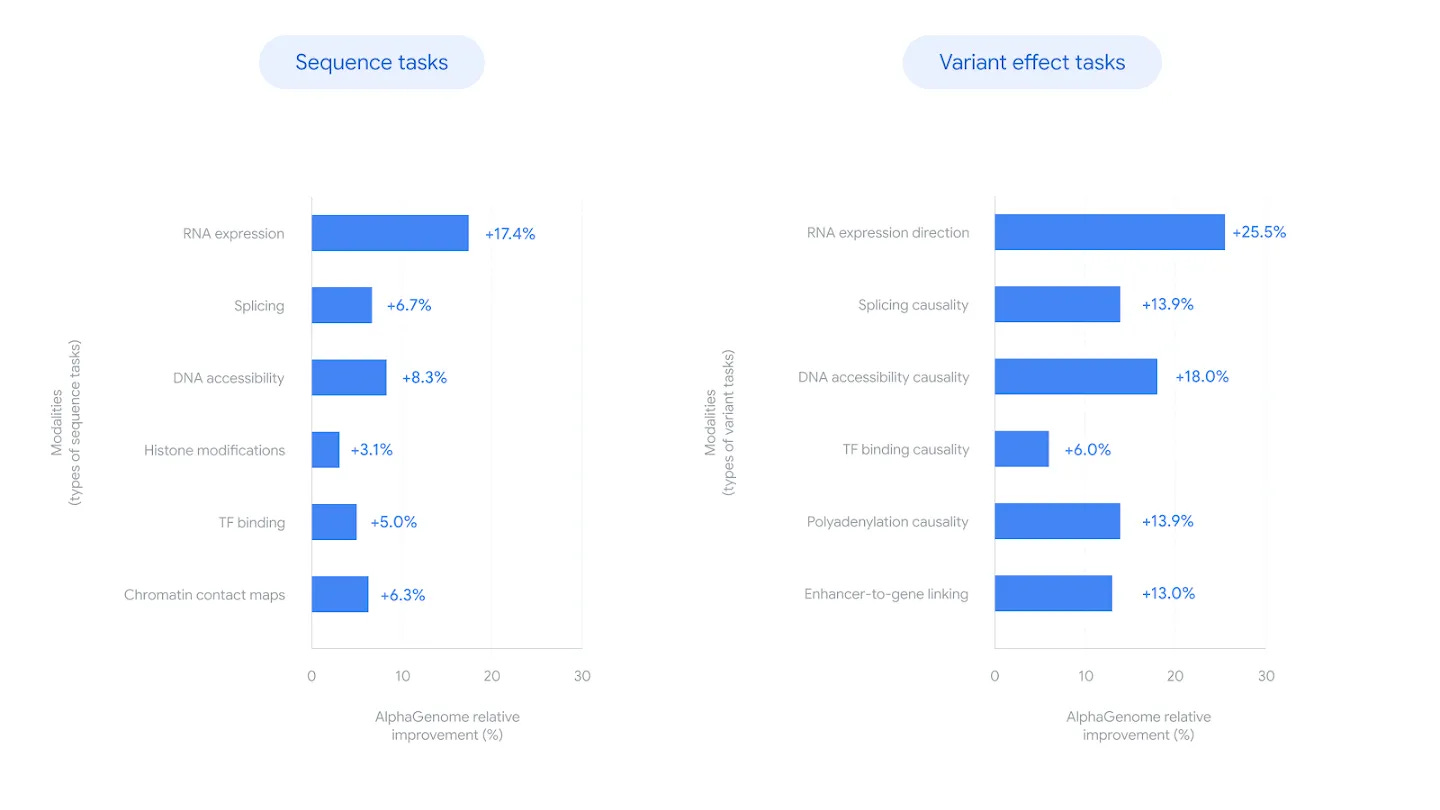
In testing, AlphaGenome outperformed existing models in 24 out of 26 evaluations. This includes gene expression, splicing, and how mutations lead to rare diseases or cancer. For example, it successfully traced how specific non-coding mutations trigger T-cell leukemia, revealing the mechanism of cancer-associated mutations.
DeepMind has released AlphaGenome for free, non-commercial use, to accelerate disease understanding, synthetic biology, and fundamental research. By simulating the effects of genetic variants before they are tested in a lab, researchers believe we can cut the timeline for personalized gene therapies by years.
Learn With My Friends and Me…
Other Reading…
No, China Doesn’t Plan 1000 Years Ahead (Noah Smith)
A Few Random Notes From Claude Coding (Andrej Karpathy)
The Adolescence of Technology (Dario Amodei)
ByteDance, Alibaba to Launch New Models in Race for AI Supremacy in China (The Information)
On X…



This is actually crazy. Feels like we are living in a sci-fi movie. Looking forward to seeing what health/physical problems we overcome in our lifetimes with this
This is the technology to solve the hardest health problems and create real abundance. From listening to the pod the challenge to achieving that in our lifetimes is aligning incentives and fixing the principal–agent problem.