
Anthropic Raises $65B at $965B, Passing OpenAI
A summary of the interesting content that I consumed this past week…
What I Read This Week: a summary of the content that I consumed this past week…
Caught My Eye…
1) Anthropic Raises $65B at $965B, Passing OpenAI
On May 28, Anthropic announced a $65 billion Series H at a $965 billion valuation. The round more than doubles the company’s $380 billion mark from February and clears OpenAI’s $852 billion close in late March. It’s the first time Anthropic has been valued above its primary frontier competitor, OpenAI.
The same day, Claude Opus 4.8 shipped at the same $5 / $25 per million token price as 4.7. SWE-bench Pro climbed to 69.2% from 64.3%, and Anthropic claims the model is roughly four times less likely to leave bugs in its own code unremarked. Their evaluations also showed that Opus 4.8 is the first Claude model to get a perfect score on their benchmark that tests for lazy thinking and work. This means instead of cutting corners and making assumptions on unintuitive and poorly documented code bases, it will trace things down fully to avoid significant misunderstandings.
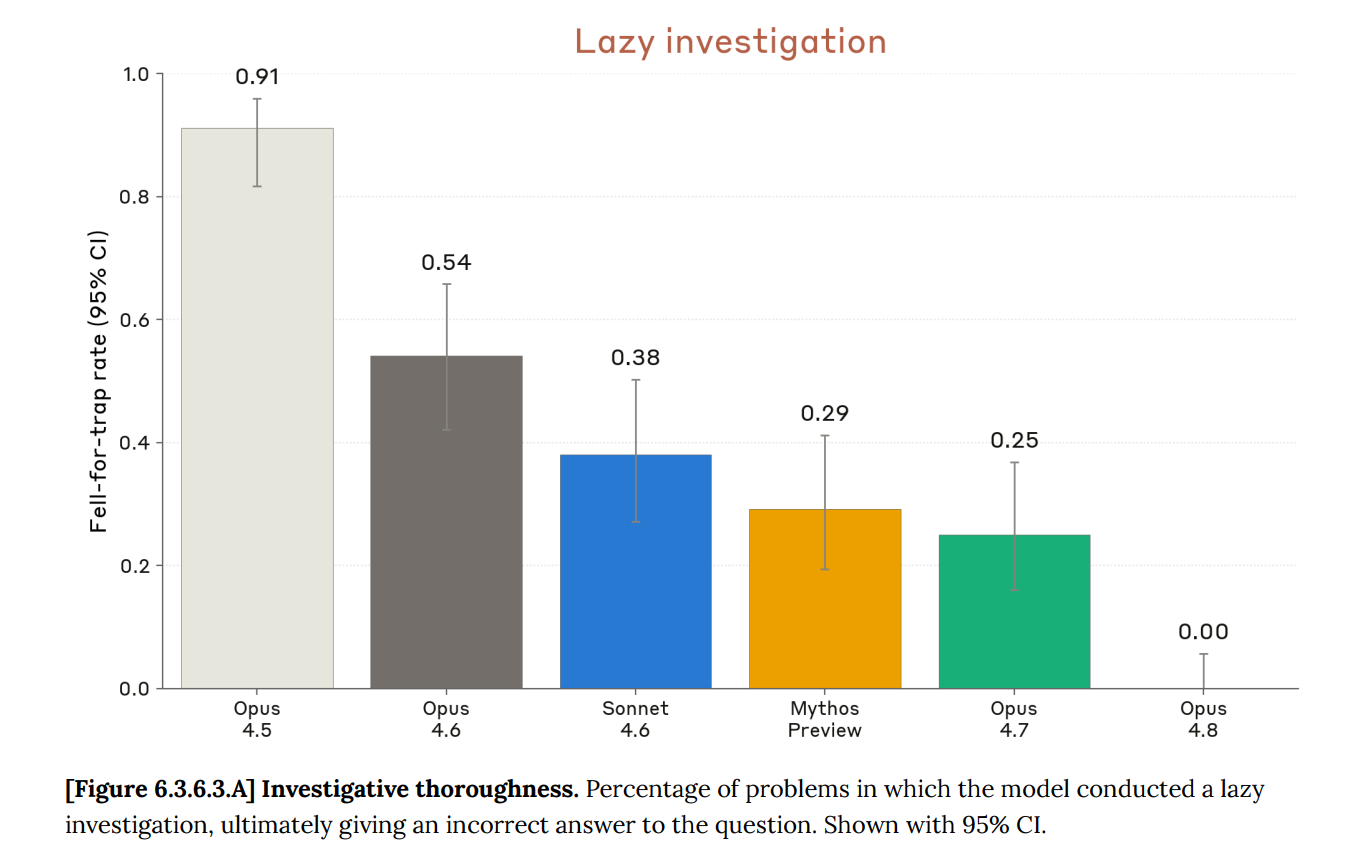
Anthropic says Mythos-class capability will reach all customers “in the coming weeks,” and added that no lab has yet built safeguards strong enough to prevent misuse.
2) Pluralis Trains a 7.5B Model Across 198 Cities
Pluralis Research, a research lab focused on collectively-owned AI, previously completed Node0-7.5B, a 36-billion-token pretraining run executed over three weeks using 1,642 GPUs across 198 cities. Most contributions came from consumer-grade Nvidia 4090s and 6000-series cards. Founded in 2024 by ex-Amazon ML scientist Alexander Long, Pluralis raised a $7.6M seed led by USV and CoinFund, with Variant, Topology, Bodhi Ventures, Balaji Srinivasan, and Clem Delangue participating.
Pluralis recently went live with Pluralis-8B on their new Agora system, an 8-billion-parameter language model being trained across roughly 50 cities on a mix of consumer GPUs and small datacenters connected over ordinary internet.
The company’s approach is called Protocol Learning. They split the model into pieces distributed across participants such that no single party can reassemble the full weights, while the math still produces a working model whose inference revenue flows back to contributors. The mechanism, described in NeurIPS 2025’s “Unextractable Protocol Models“ paper, periodically scrambles the seams between those pieces in a way that preserves model behavior but blocks reconstruction.
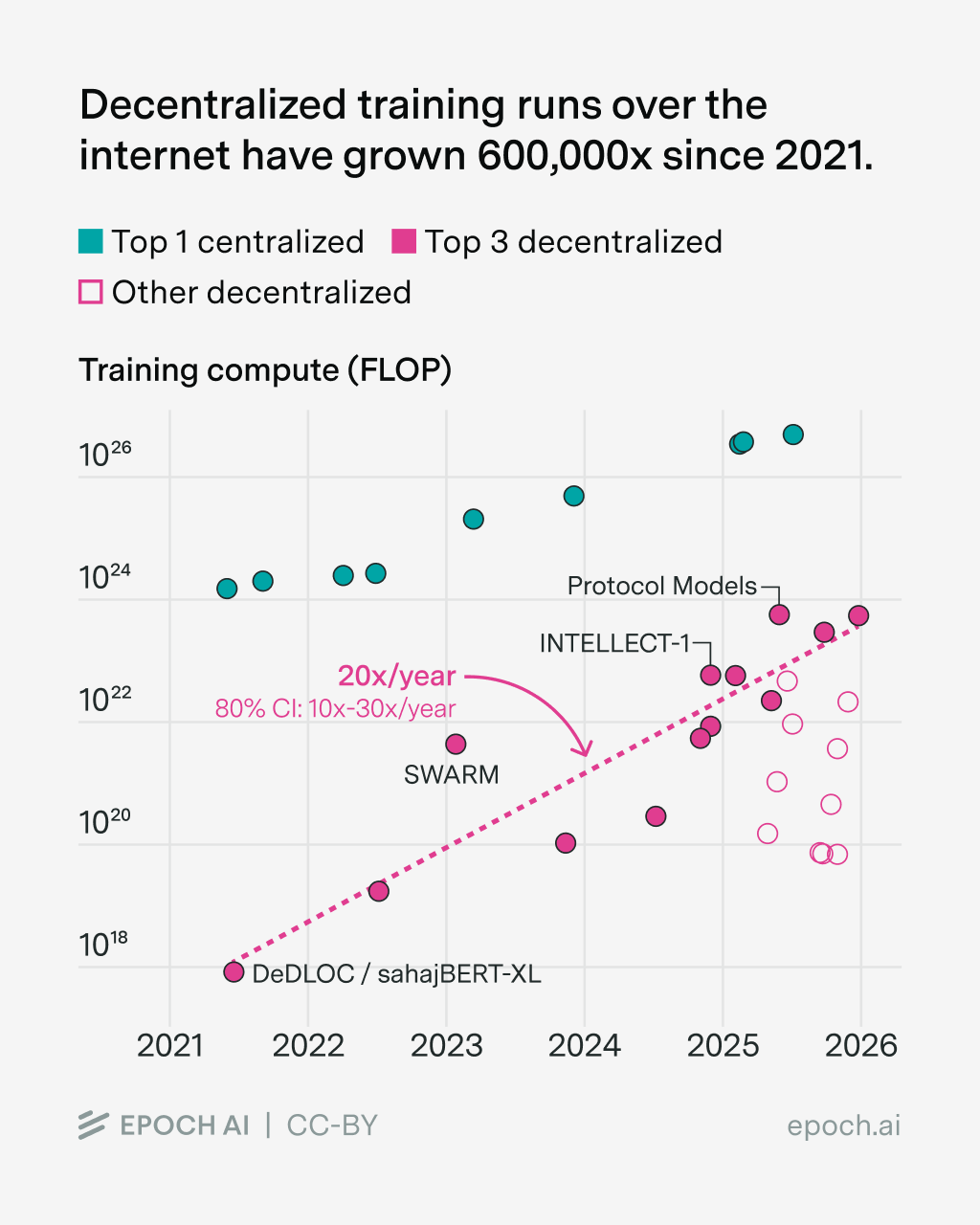
EpochAI has calculated that the growth rate of frontier AI training is 5x/year. In comparison, they measure that decentralized runs are scaling at 20x per year. If both trends hold, it would take five and a half years for decentralized training to catch up.
“Pluralis paves the way to true collective ownership at the model layer, by training foundation models that are split across geographically separated devices connected only over the internet. It guarantees public access to strong base models, enables anyone to participate in the economic benefits of AI, and unlocks open innovation. There may be no technical challenge today that has a larger impact.” - Alexander Long, Founder and CEO, Pluralis Research
3) Quantinuum Sets $1B IPO Terms at $12.7B Valuation
On May 26, Quantinuum filed an amended S-1 setting the price range for its Nasdaq IPO at $45 to $50 per share on 21 million Class A shares. The deal targets up to $1.05 billion in proceeds at a $12.7 billion fully diluted valuation, with trading expected on or around June 3 under ticker QNT. It is the first traditional IPO from a full-stack quantum computing company, while every prior public-market quantum entry has come through a SPAC.
Quantinuum builds quantum computers using individual trapped ions as qubits, a different physical approach from the superconducting-circuit machines that Google and IBM run. The company was formed in November 2021 when Honeywell spun out its internal quantum hardware division and merged it with Cambridge Quantum, a UK quantum-software firm. Honeywell has remained the majority shareholder and has led multiple follow-on funding rounds. Its current commercial system, Helios, runs 98 physical qubits and 48 logical qubits, the error-corrected ones that actually run useful programs. Their launch customers include Amgen, BMW, JPMorgan Chase, and SoftBank. After the IPO, Honeywell will retain about 49.1% of voting power.
2025 revenue came in at $30.9 million, up from $23 million the year prior, against a $192.6 million net loss. The company has spent more than $2 billion on R&D over the past decade and held $677 million in cash at quarter-end.
Learn With My Friends and Me…
Anthropic’s Digital God, Pope vs AI, Job Loss Narrative Flips, Open Source Crackdown Coming?
Other Reading…
Avoiding Death on the Yellow Brick Road (Joe Schmidt)
Rogo’s Big Finance Bench (Rogo)
On X…


Sitting on my toilet and just took a big #Chamath. Dude, next article, can you tell us the art of how one moves from tech dork to trying to be cool? Once a tool, always a tool. What SPAQ are you going to pawn off on us or what pedophile grifter are you going to kiss up too to serve the interests of your big ass Indian nose. Who is uglier? You or eyeballs Patel?
Now the question is, as someone who only owns index funds but has been using AI for years , and came to the conclusion that Claude is far better than anything else, should I buy shares?