Caught My Eye…
1) Humanoid Company Surges 460% in Record-Breaking $50B IPO
Unitree makes four-legged and human-shaped robots. On August 19, it became the first humanoid-robot company listed on mainland China’s Shanghai STAR Market, a general equivalent to the Nasdaq that focuses on high-tech, science, and engineering startups.
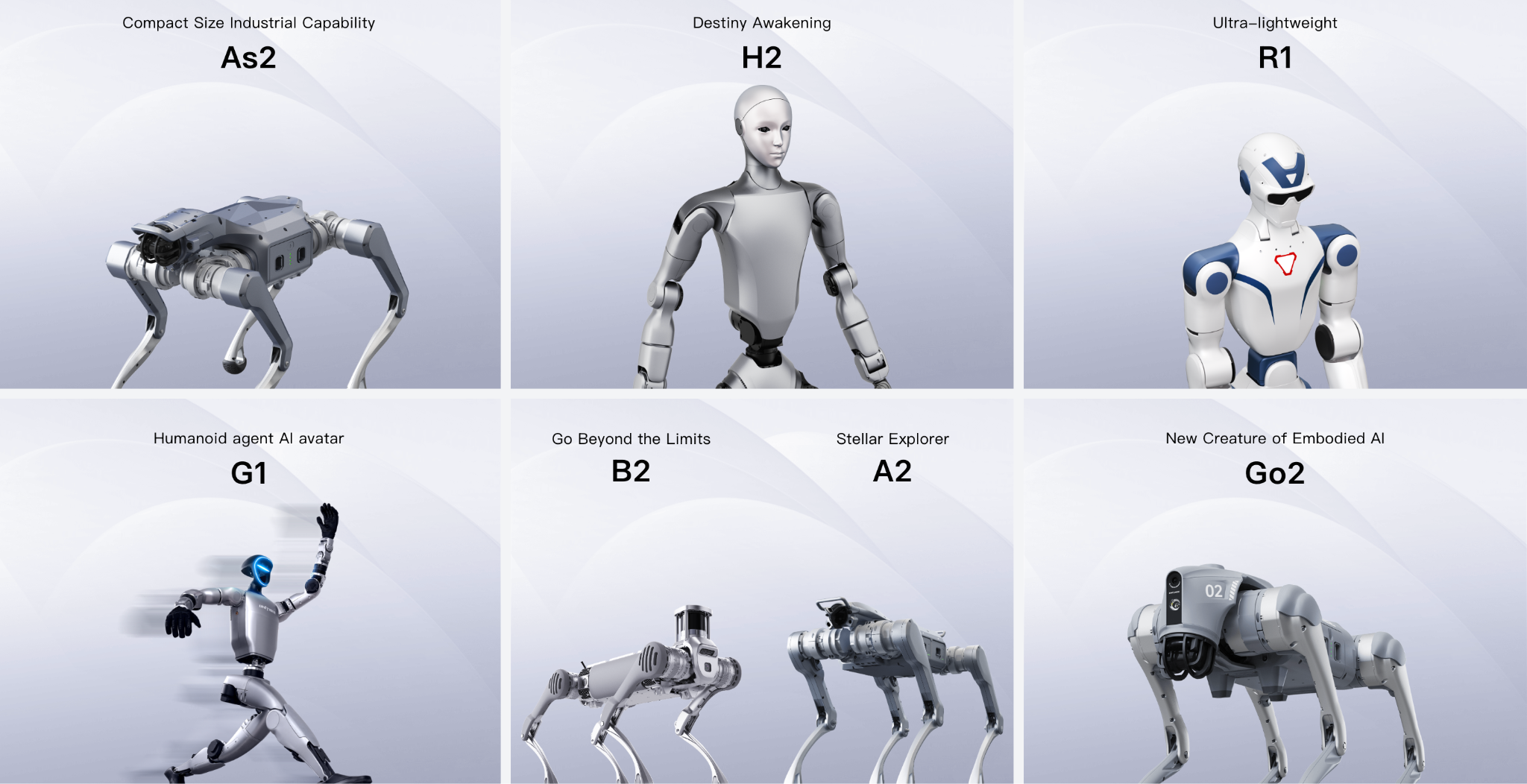
Unitree sold shares for 150.80 yuan (~$22.44) each and raised 6.1 billion yuan (~$904 million). It was oversubscribed more than 8,000 times, a market record, with 9.8 million retail accounts chasing shares. The stock closed at 845 yuan, up 460% on the first day, valuing Unitree at about $50.7 billion.
Unitree is one of the few humanoid makers that is currently profitable. They already shipped more than 5,500 in 2025, more than any other company that year. Its revenue reached 1.7 billion yuan, more than four times its 2024 sales, and profit was 278 million yuan.
In total, Chinese manufacturers made roughly 90% of the ~16,000 humanoids shipped worldwide in 2025, and in June, Morgan Stanley doubled its 2026 Chinese shipments forecast to 50,000 units.
In comparison, the American field is priced mostly in private rounds. Figure carries a $39 billion valuation from its September 2025 Series C, and Agility Robotics is going public through a SPAC merger at about $2.5 billion.
Tesla runs 1,000 to 1,200 Optimus units inside its own plants, and plans to make them available for sale to the public by the end of 2027. Unitree’s market moves now give investors a public price to compare with the values assigned in private funding deals.
2) The $2.7 Billion Short Squeeze: Bitcoin’s Best Week Since 2024
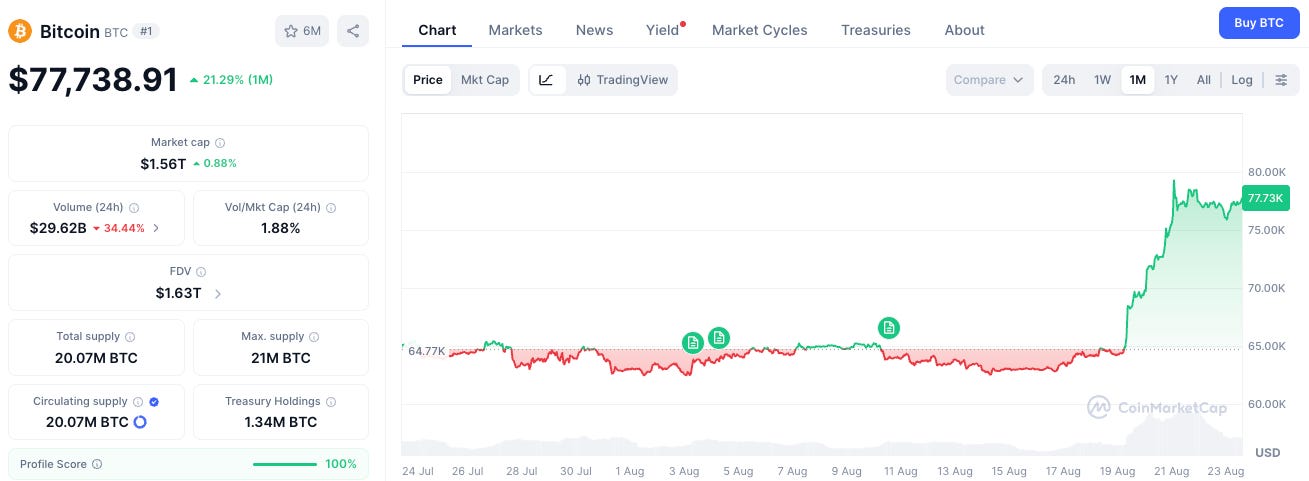
Bitcoin rose more than 24% this week to above $78,000, its best weekly gain since March 2024. The rally came alongside a series of signals that Washington is becoming more accommodating toward crypto, then accelerated as traders betting against the market were forced to close their positions.
On August 18, the SEC proposed new exemptions that could make it easier for crypto projects to sell tokens to the public. Today, doing so can require extensive financial disclosures, legal filings, and ongoing reporting similar to what companies provide when selling securities. Under the proposal, smaller crypto projects could raise limited amounts of money with much simpler disclosures. Larger projects could raise up to $75 million a year under lighter requirements.
The SEC also proposed a path for some tokens to eventually stop being regulated as securities once they no longer depend on the company or team that originally created them. The public has 60 days to comment before the SEC decides whether to adopt the rules.
Congress is also trying to settle a bigger question that has hung over crypto for years: which parts of the industry should be regulated like securities and which like commodities. The CLARITY Act would draw that line, leaving securities and crypto fundraising largely with the SEC while giving the CFTC broader authority over trading in digital commodities. It would also create a legal framework for crypto exchanges to operate in the U.S.
The bill stalled before the Senate’s August break, but regulators signaled they may move ahead anyway. On August 20, CFTC Chairman Michael Selig said his agency could write crypto rules using powers it already has if Congress fails to act.
The day before, President Trump said the CFTC was working to bring Hyperliquid, a major crypto trading platform that currently blocks U.S. users, into the country “in a fully compliant and legal fashion.” The announcement was followed by a more than 30% rally in Hyperliquid’s token. Together with the SEC proposal, the message to investors was that Washington is moving toward making it easier for crypto businesses and markets to operate legally in the U.S.
Those policy signals landed in a market already positioned for crypto prices to fall. As prices rose, short sellers were forced to buy back their positions, pushing prices even higher. In 24 hours, $2.74 billion of crypto shorts were liquidated, the largest short-side liquidation wave in CoinGlass records going back to 2021. The Treasury also said it would at least double its long-term debt buybacks to $4 billion at a time, adding another potential source of liquidity for risk assets.
3) Moderna Surges 177% on Positive Phase 3 Cancer Vaccine Results
On August 19, Moderna and Merck reported that their personalized cancer treatment succeeded in a Phase 3 trial, the first large late-stage study of a custom cancer therapy built using the same mRNA technology as Moderna’s COVID vaccine.
All 1,137 patients had advanced skin cancer removed by surgery first. Two-thirds then got the custom shot plus Keytruda, a widely used cancer drug, and a third got Keytruda alone. Patients who received Moderna’s custom treatment with Keytruda went longer without their cancer returning or spreading than patients who received Keytruda alone. Moderna shares closed Wednesday 177% higher, their largest one-day gain on record.
Moderna has shown the treatment can work, but it has not yet disclosed how much better the combination performed. The company also has not shown whether patients lived longer, which it is still measuring.
The treatment starts by reading the genetic code of each patient’s tumor. Moderna then creates a custom shot targeting as many as 34 mutations found in that cancer. The shot teaches the immune system what to attack, while Keytruda blocks one of the mechanisms cancer uses to hide from immune cells. It is given after surgery to reduce the risk of the cancer returning, not to shrink a tumor that is still present. Melanoma is also just one of nine cancers being studied across the program.
Additionally, if the treatment ultimately reaches broad use, manufacturing could become one of the biggest challenges. Unlike a conventional drug made identically for every patient, each treatment must be designed and produced for one individual, quickly enough to fit a medical treatment schedule and cheaply enough for insurers to cover it.
Learn With My Friends and Me…
All-In: Dario Defends Himself, Datacenter Panic, AI Doomer Trap, Senate Toss-Up
Deep Dive: The Next Trillion-Dollar Futures Market

AI capex hit $765B in 2026, passing oil and gas for the first time. The resource powering AI is getting its first futures contract. Here is what has to be true for it to work…
Other Reading…
On X…