
Meta’s Multi-Billion, Multi-Year Nvidia Partnership
This represents the first large-scale NVIDIA Grace-only deployment, when hyperscalers typically source general-purpose CPUs from...
What I Read This Week: a summary of the content that I consumed this past week…
Caught My Eye…
1) Meta’s Multi-Billion, Multi-Year NVIDIA Partnership
On February 17, 2026, Meta and NVIDIA announced a long-term infrastructure partnership to expand Meta’s AI-optimized data centers. The agreement covers millions of NVIDIA Blackwell GPUs and next-generation Rubin GPUs. Meta will also integrate NVIDIA Spectrum-X Ethernet into its networking infrastructure. This will speed up their deployment at scale, unlocking gains in AI training efficiency and shortening time to insights.
Meta says it will deploy NVIDIA Grace CPU-only servers at large scale, with NVIDIA’s next-gen Vera CPUs planned later. This represents the first large-scale NVIDIA Grace-only deployment, when hyperscalers typically source general-purpose CPUs from Intel and AMD.
Meta and NVIDIA described this initiative as deeper co-design, positioning it as a systems-level effort to improve performance per watt rather than a single component purchase.
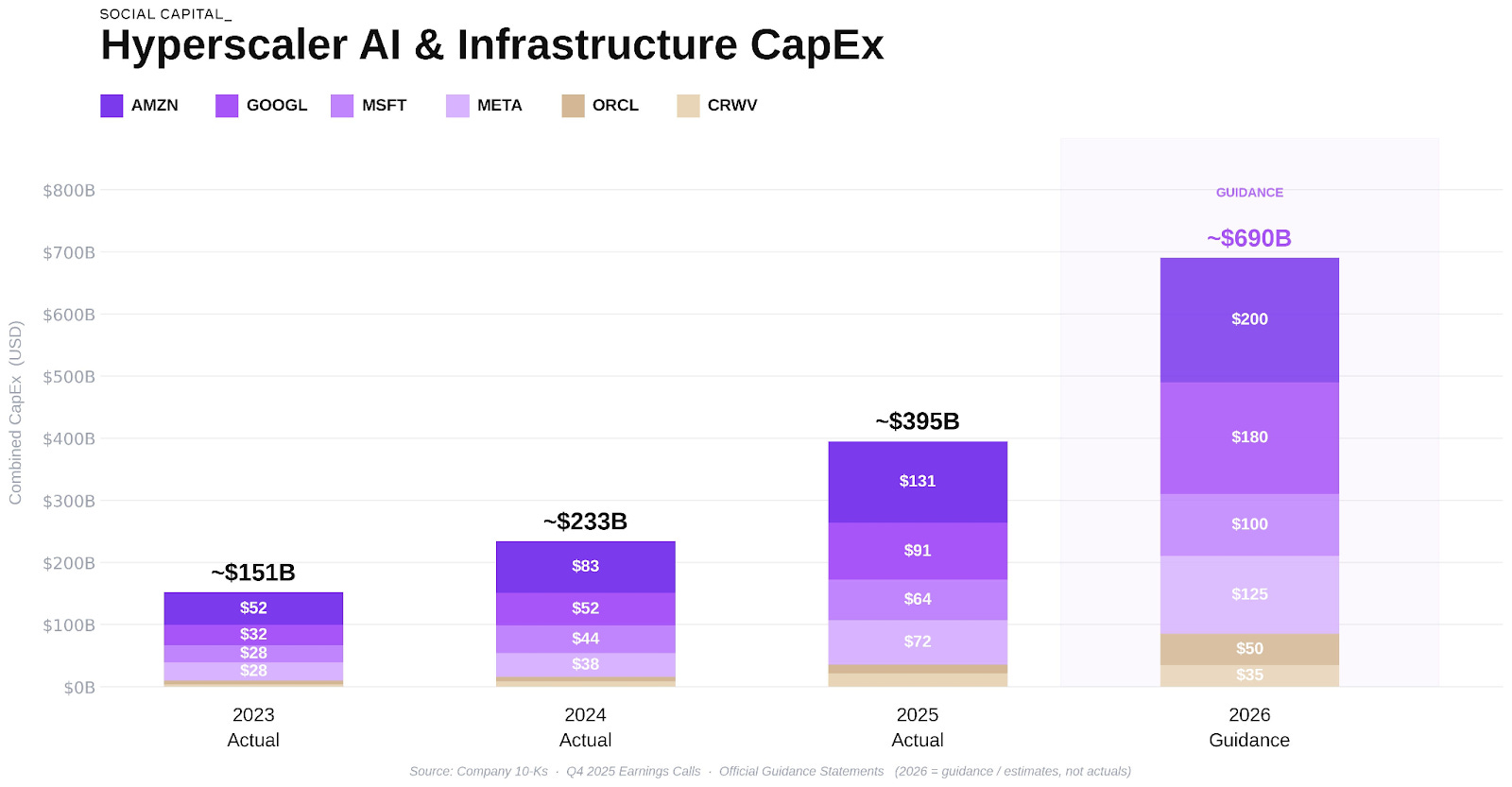
This partnership lands inside Meta’s newly raised 2026 capex outlook of $115–$135B, up roughly 75% from 2025, and is almost entirely focused on its Superintelligence Labs efforts. Zooming out, the infrastructure race is still going strong, with multiple hyperscalers raising their 2026 capex guidance.
2) The Fed Pricing in AI and Prediction Markets
On Feb. 18, 2026, the Fed released minutes from its Jan. 27-28 meeting. Officials kept rates at 3.50%–3.75% (10–2, with two dissenting for a 25 bp cut). This shows a patient approach amid steady growth, a balanced labor market, and inflation above target.
The Committee viewed AI as a key factor in their decisions. The minutes mention a “strong pace of AI-related investment,” linking productivity gains to economic support.
However, they also noted that firms are cautious about hiring due to uncertainty over how AI and automation will affect labor demand. They flagged AI as a source of forecast uncertainty and a potential financial risk, citing high valuations, concentration, and AI projects funded through opaque private markets that require oversight.
Federal Reserve Governor Michael Barr echoed this view the day before. He emphasized the uncertainty about monetary policy’s impact on structural factors such as AI. In the short term, he expects painful labor market disruptions, but in the long term, he believes the labor market will eventually adjust, creating new jobs and enhancing others, which will boost real wages.
That same week, a new Fed working paper suggested they should monitor prediction markets. The paper found that Kalshi can provide real-time probability distributions for inflation, unemployment, GDP, and specific Fed funds outcomes that traditional tools often miss.
Since 2022, Kalshi’s median/mode have accurately matched the next meeting’s decision the day before FOMC meetings, outperforming fed funds futures. Additionally, Kalshi’s CPI forecasts, especially the median/mode, have surpassed Bloomberg consensus. Notably, the distributions showed a bias: upside CPI surprises influenced expected policy paths more than downside surprises.
3) J&J’s New 2 Million sq ft Cell Therapy Facility
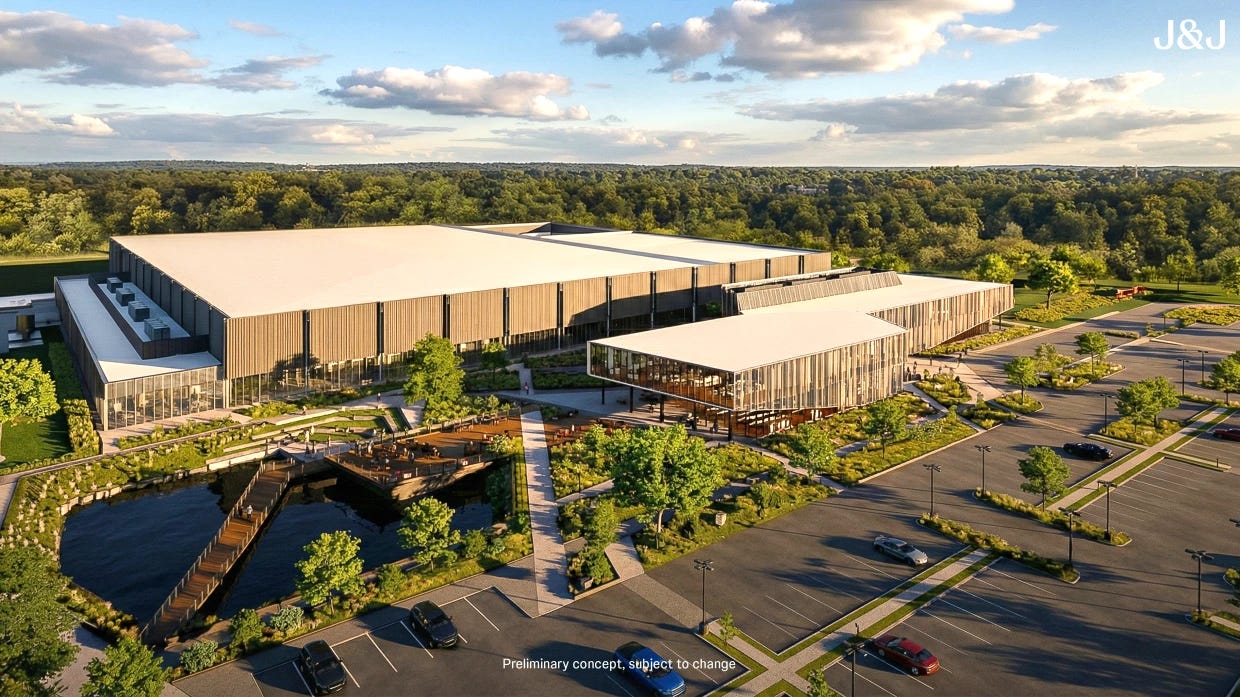
On February 18, 2026, Johnson & Johnson announced a $1B+ investment to build a next-generation cell therapy manufacturing facility in Montgomery County, Pennsylvania. The site is designed to expand J&J’s U.S. production capacity for advanced therapies that support its medicines portfolio and pipeline, including treatments in cancer, immune-mediated, and neurological diseases.
The company positioned the project as both a technology and workforce play. This investment aims to advance cutting-edge manufacturing processes and train a workforce with skills in advanced technologies shaping the future of medicine.
J&J estimates it will create more than 500 skilled biomanufacturing jobs once fully operational, and more than 4,000 construction jobs during development. J&J also estimates a ~$10B annual economic boom to the state, with 10 facilities totaling more than 2 million square feet across manufacturing, research, distribution, and office operations.
J&J tied the investment to its previously announced plan to invest $55B in the U.S. through early 2029 across manufacturing, R&D, and technology. The goal is to support manufacturing the vast majority of its advanced medicines in the U.S. for U.S. patients.
Learn With My Friends and Me…
Deep Dive: How Machines Are Becoming Better Investors Than Humans

Today, public and private information are instantly priced in. As such, strategies that depend on reacting to news, reading filings, or “having an opinion” compete in a game where the half-life of new information is measured in milliseconds.
Unsurprisingly, the best long-term returns in modern investing come from...
Other Reading…
Kalshi and the Rise of Macro Markets (Federal Reserve)
Multi-Agent Cooperation Through In-Context Co-Player Inference (ARXIV)
Measuring AI Agent Autonomy in Practice (Anthropic)
On X…


Totally get the sentiment here, this feels like a necessary smack of reality in a world where everyone’s selling the future as something that’s already arrived. The real work and risk is in execution and discipline, not the shiny slogans or rallying cries, and if we ignore that we’re just painting over the tough bits with louder language.
What is your take on this? https://x.com/citrini7/status/2025653614430023864?s=46&t=KmVnI0vA5iaMma61Sg2K0Q