
Ramp’s $44B bet on metered intelligence as corporate spend
A summary of the interesting content that I consumed this past week…
What I Read This Week: a summary of the content that I consumed this past week…
Caught My Eye…
1) OpenAI third phase: an AGI for everyone
On June 8, OpenAI submitted a confidential draft S-1 to the SEC, announcing the filing itself. The filing came one week after Anthropic disclosed its own IPO preparations. OpenAI was last valued at $852 billion in March; Anthropic closed its Series H at $965 billion on May 28.
The same day, Sam Altman and Jakub Pachocki published “Built to benefit everyone,” declaring a “third phase” for the company built around three goals: (1) an automated AI researcher, with ‘a significant fraction’ of OpenAI’s research done by AI by March 2028; (2) faster economic growth; and (3) a personal AGI for everyone on Earth. Their first phase was a research company; their second was a product company. Now they want to expand into a broader distribution company that ensures everyone can thrive with these tools.
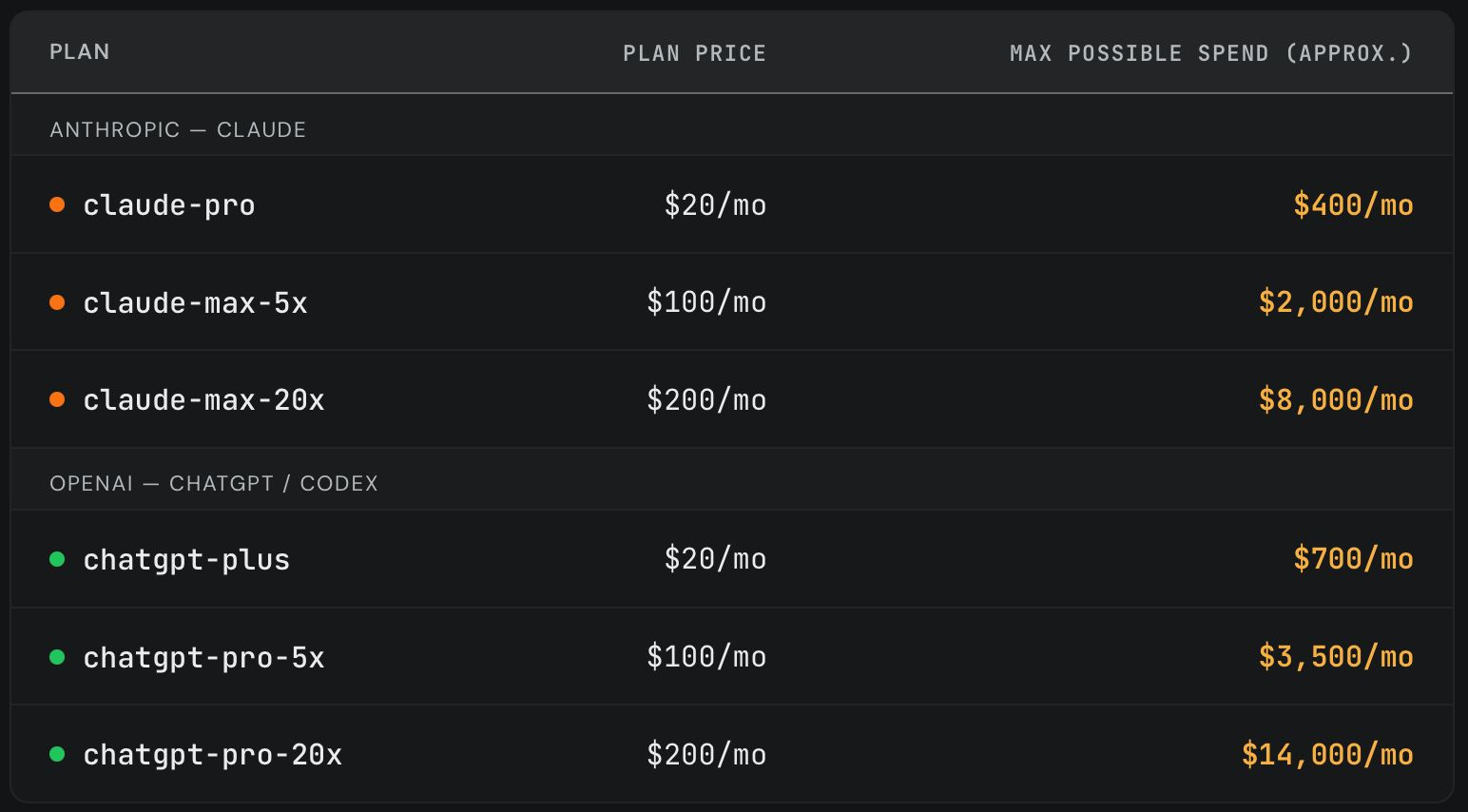
The WSJ reported OpenAI is weighing sharp cuts to token prices in anticipation of similar cuts at Anthropic. The same week, SemiAnalysis measured how much usage the flat-rate AI plans allow: a $ 200-per-month ChatGPT Pro subscription can draw up to $14,000 in tokens per month at API prices; Claude Max, $8,000. SemiAnalysis pegs the cost of serving tokens at roughly a quarter of API list price, in line with the ~75% inference margins both labs are reported to earn. At that rate, a maxed-out Pro user costs OpenAI about $3,500 in compute against $200 in revenue.
And on June 11, OpenAI agreed to acquire Ona, whose customer-controlled cloud environments let Codex agents keep working for hours or days inside a company’s own infrastructure. Codex now counts 5 million weekly users, up 400% this year.
2) Bezos takes a CEO seat to build an artificial general engineer
On June 11, Project Prometheus emerged from stealth with a $12 billion Series B at a $41 billion valuation. The company is seven months old, employs roughly 150 people across San Francisco, London, and Zurich, and is co-run by Jeff Bezos and Vik Bajaj, the Google X veteran who co-founded Alphabet’s Verily, an artificial intelligence and precision health company. It is Bezos’s first CEO seat since he left Amazon in July 2021.
Prometheus is building what Bezos calls an “artificial general engineer”: AI tools that compress the design-to-manufacturing cycle for physical objects, from bridges to chips, which he described as a very modern version of CAD that makes the build loop 10 times faster. The constraint it claims to solve is data. Language models were trained on the internet; engineering AI needs physics-grounded simulation and proprietary test results that largely don’t exist online. Prometheus generates most of that data itself, supplemented by results from manufacturers. Target industries are computing, aerospace, automotive, advanced manufacturing, and drug discovery.
Bezos believes AI will bring “labor scarcity” rather than mass unemployment, his term for a world where productivity lets companies take on more projects than they have people to staff. He also believes that with a higher standard of living and productivity, people can choose to work less or scale down their workload.
3) SpaceX reveals AI1 data center satellite
On June 8, three days before pricing its IPO, SpaceX revealed AI1, its first orbital data center satellite. The spacecraft targets 120 kW of sustained compute (150 kW peak) at roughly 600 km altitude, with a 70-meter wingspan, wider than a Boeing 747-8, and a 110-square-meter liquid radiator to dump waste heat into space. The compute payload is interchangeable, so chips can be swapped as hardware generations turn over. Two prototypes are slated for early 2027, and SpaceX has filed plans for a constellation of up to 1 million satellites.

On Friday, June 12, SpaceX began trading on Nasdaq as SPCX in the largest IPO in history. Priced at $135 a share the night before, a $1.77 trillion valuation that raised about $75 billion, the stock opened at $150, ran as high as $176.52, and closed up roughly 19% near $161, pushing SpaceX past a $2 trillion valuation on its first day and making it the sixth-largest U.S. public company.
The heavily oversubscribed deal more than doubled Saudi Aramco’s $29.4 billion fundraising record. SpaceX says proceeds will fund AI compute infrastructure first, then launch vehicles and satellite constellations.
To get a full picture of SpaceX, we just published our 120-page SpaceX Deep Dive, covering everything from launch economics to the orbital compute thesis and more.
4) Ramp’s $44B bet on metered intelligence as corporate spend
On June 4, Ramp raised $750 million at a $44 billion valuation, nearly triple its value a year ago, on more than $1 billion in annualized revenue with positive free cash flow. Ramp is a corporate spend platform (cards, expenses, bill pay, and procurement) serving more than 70,000 businesses. The core thesis is that AI tokens have become a major corporate cost that current financial systems can’t model well. Ramp is now betting that helping companies measure and control those costs will open up a new revenue opportunity.
CEO Eric Glyman’s accompanying essay, “The Third Pillar,” argues that business spending ran on two pillars, people and vendors. Metered intelligence is now the third.
Their new early-access product pulls token-level usage data from Anthropic, OpenAI, Gemini, and Cursor into a single dashboard, attributes it to teams and use cases, and recommends routing work to cheaper models. The spread it monetizes is wide: GPT-4-level intelligence has fallen from $60 to roughly $0.40 per million tokens since 2023, while businesses rely on more expensive frontier models for menial tasks. Rerouting 10% of a $10 million AI bill from frontier to commodity intelligence saves nearly $1 million.
Learn With My Friends and Me…
Anthropic's Fable Backlash, Nationalizing AI, Inflation Heats Up & California’s Broken Elections
Other Reading…
China’s Unitree Will Dominate Global Robotics (SemiAnalysis)
A Manufacturing Revolution Is Happening—in Space (The Free Press)
Policy on the AI Exponential (Dario Amodei)
On X…


Will the government really let companies create AGI? How can AGI possibly be controlled? What if it disagrees with our social or political structure?
We could see a compromise 🔔by 9 am tomorrow Monday.📉 Considering this effects Claude’s IPO. I wonder if Mythos game theorized these strategic steps. Their publicity stunts are not always as they seem.